🌍 Geography as a Discipline
📍 Module 1: The Nature of Geography
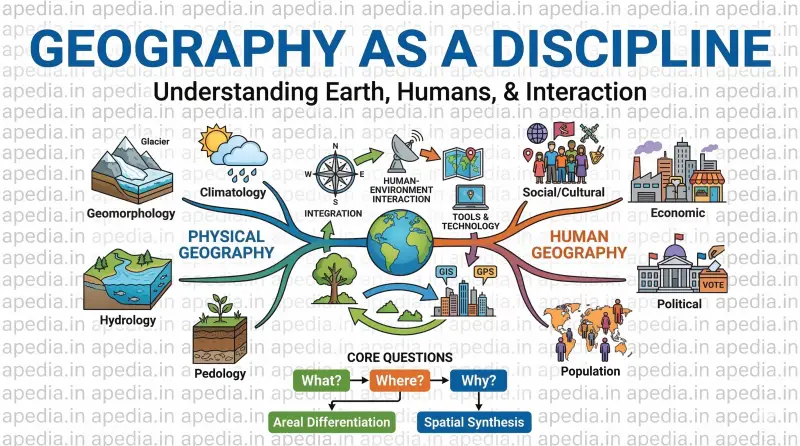
Geography is fundamentally the description of the earth. The term was first coined by the Greek scholar Eratosthenes (276-194 BC), derived from the Greek words geo (earth) and graphos (description). The earth is characterized by immense variations in its physical features (mountains, oceans, plains) and cultural features (cities, roads, markets). Because of these variations, geography is logically perceived as the study of areal differentiation, meaning it studies phenomena that vary over space.
Human-Environment Interaction
Geography studies the interactive relationship between ever-changing nature and ever-active human beings. While primitive societies were directly dependent on their physical environment, modern humans have modified nature using technology. This dynamic relationship has led to the creation of "humanised nature and naturalised human beings".
📝 Concept Check 1
1. Who first coined the term 'Geography'?
Eratosthenes
2. What do the Greek roots "geo" and "graphos" mean?
Earth and Description
3. The study of variations of phenomena over space is known as?
Areal differentiation
4. What allowed human beings to loosen the shackles of their physical environment?
Technology
🔗 Module 2: An Integrating Discipline
Geography is a discipline of synthesis. While history attempts temporal (time-based) synthesis, geography attempts spatial synthesis. It recognizes the world as an interconnected system and derives its database from both natural sciences (like geology and botany) and social sciences (like economics and sociology).
The Three Core Questions
- What? Identifying the patterns of natural and cultural features.
- Where? Understanding the distribution and locational aspects of these features.
- Why? Explaining the causal relationships between features and processes. This third question is what truly makes geography a scientific discipline.
🌳 Module 3: Branches of Geography
The study of geography is broadly divided into two major approaches: the Systematic approach and the Regional approach.
Systematic vs. Regional Approaches
- Systematic Approach: Introduced by German geographer Alexander Von Humboldt. A phenomenon is studied worldwide as a whole, and then spatial patterns or typologies are identified. Major branches include Physical Geography (Geomorphology, Climatology, Hydrology), Human Geography (Social, Economic, Political), and Biogeography.
- Regional Approach: Developed by Karl Ritter. The world is divided into regions at various hierarchical levels, and all geographical phenomena within a specific region are studied holistically. Branches include Regional Studies, Regional Planning, and Regional Development.
📝 Concept Check 2
1. Which type of synthesis does geography attempt?
Spatial synthesis
2. Who introduced the systematic approach to geography?
Alexander Von Humboldt
3. Which branch of physical geography studies landforms?
Geomorphology
4. Which core question addresses causal relationships in geography?
Why?