🌟 Human Development
📈 Module 1: Growth vs. Development
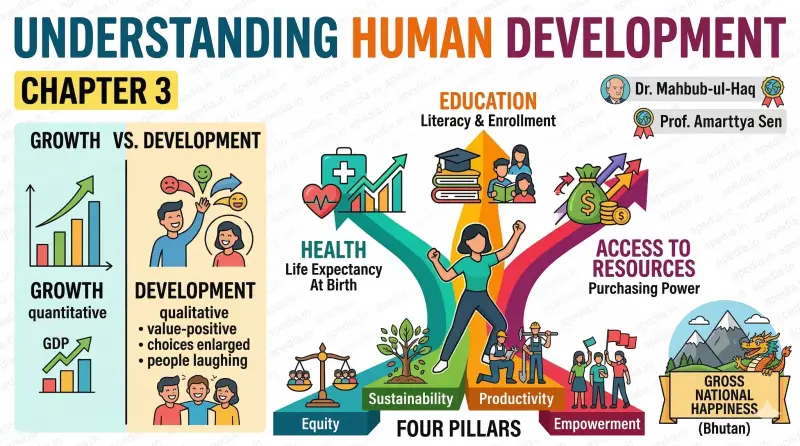
While the terms "growth" and "development" are often used interchangeably, they have distinct meanings in geography and economics. Growth is quantitative and value-neutral. It simply means an increase or decrease in size or numbers (e.g., a city's population growing from 1 lakh to 2 lakh).
Development, however, is qualitative and always value-positive. Development only takes place when there is a positive addition or improvement in the existing conditions (e.g., the city's population grows, but housing, healthcare, and education also improve).
Development, however, is qualitative and always value-positive. Development only takes place when there is a positive addition or improvement in the existing conditions (e.g., the city's population grows, but housing, healthcare, and education also improve).
The Concept of Human Development
The modern concept of Human Development was introduced by the prominent Pakistani economist Dr. Mahbub-ul-Haq. He described it as development that enlarges people's choices and improves their lives. According to this concept, people are central to all development, and the basic goal is to create conditions where people can live meaningful lives. He worked closely with Indian Nobel Laureate Prof. Amartya Sen, who emphasized that development is about increasing freedom and capabilities.
📝 Concept Check 1
1. Is economic growth always an indicator of development?
No, growth is quantitative; development requires qualitative improvement.
2. Who originally introduced the concept of Human Development?
Dr. Mahbub-ul-Haq
3. Which Indian Nobel Laureate focused on the "capability approach" to development?
Prof. Amartya Sen
4. What is the central focal point of human development?
People and enlarging their choices.
🏛️ Module 2: The Four Pillars & Approaches
Just as a building is supported by pillars, the idea of human development is supported by four foundational concepts.
The Four Pillars
- Equity: Making equal access to opportunities available to everybody, regardless of gender, race, income, or caste.
- Sustainability: Ensuring continuity in the availability of opportunities. Each generation must have the same opportunities, requiring sustainable use of environmental, financial, and human resources.
- Productivity: This refers to human labor productivity. People are the real wealth of nations, and their productivity must be constantly enriched by building capabilities in health and education.
- Empowerment: Having the power to make choices. Such power comes from increasing freedom and capability, supported by good governance and people-oriented policies.
Approaches to Human Development
- Income Approach: The oldest approach, linking development directly to income levels.
- Welfare Approach: Looks at human beings as beneficiaries of all developmental activities (education, health, amenities) funded by the government.
- Basic Needs Approach: Proposed by the ILO (International Labour Organisation). Focuses on six basic needs: Health, Education, Food, Water Supply, Sanitation, and Housing.
- Capability Approach: Associated with Amartya Sen. Focuses on building human capabilities in the areas of health, education, and access to resources.
📏 Module 3: Measuring Human Development
Since 1990, the United Nations Development Programme (UNDP) has published the Human Development Report annually. It measures countries based on the Human Development Index (HDI) and the Human Poverty Index (HPI).
Indicators of HDI
- Health: Evaluated by Life Expectancy at Birth. A higher life expectancy indicates a longer, healthier life.
- Education: Evaluated by the adult literacy rate and the gross enrollment ratio. It shows how easy or difficult it is to access knowledge.
- Access to Resources: Evaluated by Purchasing Power (in U.S. Dollars).
Each dimension is given a weight of 1/3. The HDI is a score between 0 and 1. The closer the score is to 1, the higher the level of human development. Interestingly, Bhutan is the only country in the world to officially proclaim Gross National Happiness (GNH) as the measure of the country's progress, emphasizing spiritual and cultural values over mere material wealth.
📝 Concept Check 2
1. Which agency publishes the annual Human Development Report?
United Nations Development Programme (UNDP)
2. What are the three key areas measured by the HDI?
Health, Education, and Access to Resources.
3. What is the maximum possible score on the Human Development Index?
1.0
4. Which country uses Gross National Happiness (GNH) to measure progress?
Bhutan