🌍 Human Geography: Nature and Scope
📍 Module 1: Defining Human Geography
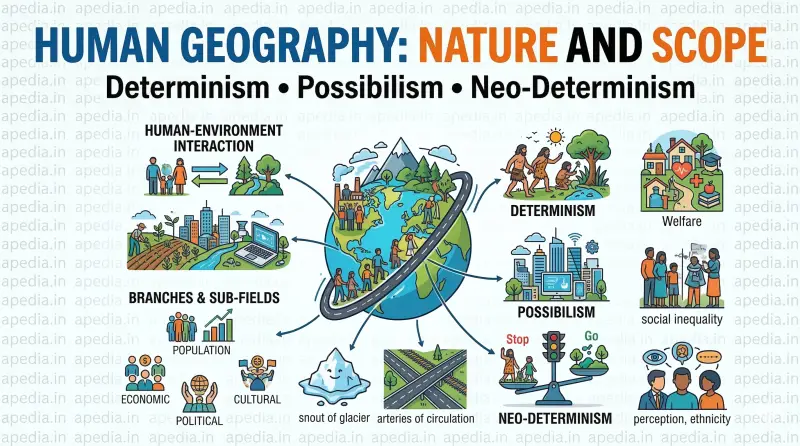
Geography is an integrative, empirical, and practical field of study that looks at the earth as the home of human beings. The dichotomy between physical and human geography is often debated, but nature and humans are truly inseparable. In fact, we often use human anatomy metaphors to describe physical features, such as the 'face' of the earth, the 'snout' of a glacier, or describing transport networks as "arteries of circulation".
Key Definitions
- Friedrich Ratzel: "Human geography is the synthetic study of relationship between human societies and earth's surface". (Focus on synthesis).
- Ellen C. Semple: "Human geography is the study of the changing relationship between the unresting man and the unstable earth". (Focus on dynamism).
- Paul Vidal de la Blache: "Conception resulting from a more synthetic knowledge of the physical laws governing our earth and of the relations between the living beings which inhabit it".
📝 Concept Check 1
1. Which geographer defined human geography emphasizing the "unresting man and unstable earth"?
Ellen C. Semple
2. Ratzel's definition of human geography heavily emphasizes what concept?
Synthesis
3. What metaphor is often used for networks of roads, railways, and waterways?
Arteries of circulation
4. Is the dichotomy between physical and human geography considered valid?
No, nature and humans are inseparable elements.
🤝 Module 2: Human-Environment Interaction
Technology is the primary way human beings interact with their physical environment. It indicates the level of a society's cultural development. By understanding natural laws (like friction, aerodynamics, or genetics), humans develop better tools to loosen the shackles of their environment.
Three Core Paradigms
- Environmental Determinism (Naturalisation of Humans): In primitive societies with low technology, humans were dictated by nature. They listened to it, feared its fury, and worshipped it (e.g., indigenous tribes living entirely off the forest).
- Possibilism (Humanisation of Nature): With cultural development, humans develop efficient technology, moving from a state of necessity to a state of freedom. Nature provides opportunities, and humans create cultural landscapes (e.g., artificially heated cities in freezing climates).
- Neo-Determinism (Stop and Go Determinism): Introduced by Griffith Taylor. It acts as a middle path between absolute necessity and absolute freedom. Humans can conquer nature by obeying its limits (like waiting for a green light at a traffic stop). A "free run" without limits leads to environmental damage like global warming.
📝 Concept Check 2
1. What indicates the level of cultural development in a society?
Technology
2. Which paradigm describes primitive humans who worshipped and feared nature?
Environmental Determinism
3. Who introduced the concept of Neo-determinism?
Griffith Taylor
4. What analogy is used to explain "Stop and Go Determinism"?
Traffic lights at cross-roads
📈 Module 3: Evolution and Schools of Thought
The study of human geography has evolved dramatically over time. It shifted from simple exploration during the Early Colonial period to complex spatial analysis and deep socio-political inquiries.
Key Historical Phases
- Quantitative Revolution (Late 1950s-1960s): Marked by the heavy use of computers, statistical tools, and physics laws to map and analyze human phenomena.
- Emergence of New Schools (1970s): Discontent with the dehumanized quantitative approach led to three new schools:
- Welfare (Humanistic) School: Focused on social well-being (housing, health, education).
- Radical School: Used Marxian theory to explain poverty, deprivation, and capitalism-driven social inequality.
- Behavioural School: Emphasized lived experiences and space perception based on ethnicity, race, and religion.
- Post-modernism (1990s): Questioned grand generalizations and universal theories, emphasizing the importance of understanding each local context individually.