🌋 Interior of the Earth: Structure and Seismic Activity
📡 Module 1: Sources of Information and Earthquakes
Understanding the Earth's interior is challenging due to extreme heat and pressure. Scientists rely on two main categories of information. Direct sources include surface rocks, materials from deep mining or drilling projects, and volcanic eruptions. Indirect sources include the analysis of temperature and pressure gradients, meteorites, gravitational anomalies, and magnetic fields.
Seismic Waves
The study of seismic activity (earthquakes) provides the most detailed picture of the earth's internal structure. An earthquake is essentially the shaking of the earth caused by a release of energy along a fault. The point of energy release is the focus (hypocenter), while the point directly above it on the surface is the epicenter.
- P-Waves (Primary): These are fast-moving waves that arrive first. Similar to sound waves, they can travel through solid, liquid, and gaseous materials.
- S-Waves (Secondary): These arrive after P-waves and are unique because they can only travel through solid materials. This characteristic helped scientists conclude that part of the Earth's core is liquid.
- Surface Waves: These are the last to arrive on a seismograph and are the most destructive, causing the displacement of rocks and structural collapse.
📝 Concept Check 1
1. Which seismic waves can travel through all states of matter?
P-waves
2. Volcanic eruptions are considered what kind of information source?
Direct Source
3. What is the point on the surface directly above the earthquake focus called?
Epicenter
4. Which waves are most responsible for structural damage?
Surface Waves
🌍 Module 2: The Structure of the Earth
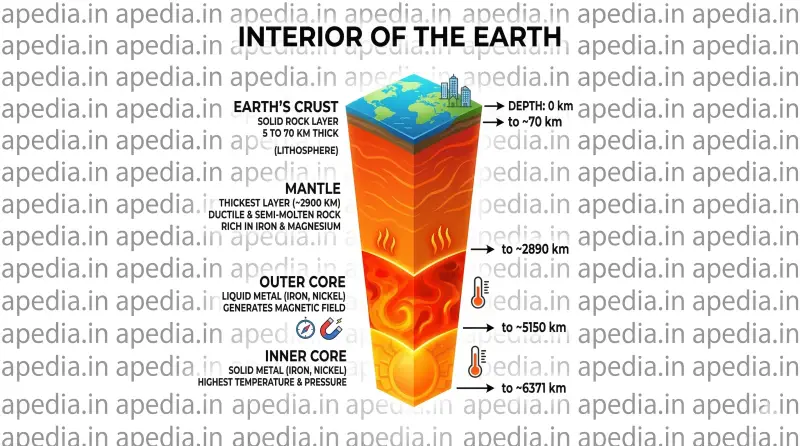
Based on the behavior of seismic waves, the Earth's interior is divided into three distinct concentric layers: the crust, the mantle, and the core.
The Three Layers
- The Crust: The outermost, brittle layer. It is relatively thin, ranging from 5 km under the oceans to about 30-70 km under the continents (thicker under major mountain systems).
- The Mantle: Extending from the base of the crust to a depth of 2,900 km. The upper portion, called the asthenosphere, is in a semi-plastic state and serves as the main source of magma. The crust and uppermost solid mantle together form the Lithosphere.
- The Core: The innermost layer. The outer core is in a liquid state, while the inner core is solid. It is primarily composed of heavy materials, specifically iron and nickel, often referred to as the "nife" layer.
📝 Concept Check 2
1. Which layer is the main source of magma during volcanic eruptions?
Asthenosphere
2. What two layers make up the Lithosphere?
The crust and the uppermost solid mantle
3. Which part of the Earth's core is in a liquid state?
The Outer Core
4. What elements predominantly make up the core?
Nickel and Iron (nife)
🌋 Module 3: Volcanoes and Volcanic Landforms
A volcano is a vent through which molten rock (magma), gases, and debris escape to the surface. Once the magma reaches the surface, it is called lava. Volcanoes are classified based on their eruption style and the landforms they create.
Extrusive vs. Intrusive Forms
- Shield Volcanoes: Made mostly of highly fluid basalt, these are the largest volcanoes and feature gentle slopes (e.g., Hawaiian volcanoes).
- Composite Volcanoes: Characterized by eruptions of cooler, more viscous lavas, creating steep, layered structures built from alternating layers of lava and ash.
- Calderas: The most explosive volcanoes that tend to collapse into themselves during an eruption, creating massive depressions.
- Intrusive Landforms: When magma cools beneath the surface, it creates various structures: Batholiths (huge, deep magmatic domes), Laccoliths (dome-shaped bodies with pipe-like conduits), Sills (horizontal magmatic sheets), and Dykes (near-vertical wall-like structures).