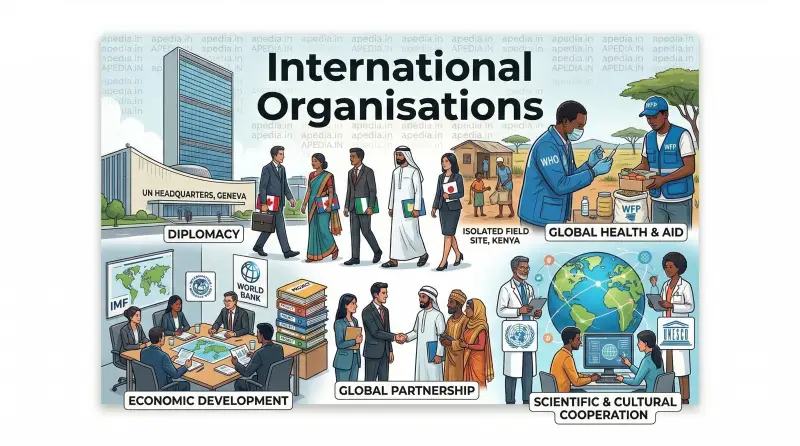
🕊️ International Organisations
🌐 Module 1: The Need and Evolution of the UN
We need international organisations not because they are super-states, but because they facilitate cooperation among member nations to resolve conflicts peacefully and tackle global challenges like diseases and climate change.
From the League to the UN
- The League of Nations: Born after the First World War, it was an initial attempt at international conflict resolution but ultimately failed to prevent the Second World War.
- Birth of the UN: The United Nations was established on October 24, 1945, right after WWII, with 51 original founding states signing the UN Charter. Its main objective is to prevent international conflict and facilitate cooperation.
- Structure & UNSC: The UN has several principal organs, the most crucial being the Security Council (UNSC). The UNSC has 5 permanent members (the US, Russia, the UK, France, and China) who possess veto power, meaning any single permanent member can block a resolution. There are also 10 non-permanent members elected for two-year terms.
- The Secretary-General: The highest representative of the UN is the Secretary-General (António Guterres being the ninth).
📝 Concept Check 1
1. Which organisation was the predecessor to the United Nations?
The League of Nations.
2. When was the United Nations founded?
October 24, 1945.
3. Who are the five permanent members of the UN Security Council?
The United States, Russia, the United Kingdom, France, and China.
4. What special privilege do the permanent members hold?
Veto power.
🛠️ Module 2: Reform of the United Nations
As the Cold War ended, the realities of global politics changed drastically. The Soviet Union collapsed, the US became the strongest power, and many new countries joined the UN. This sparked demands for reform.
The Push for Restructuring
- The 1992 Resolution: The UN General Assembly adopted a resolution highlighting three main complaints: the UNSC no longer reflects contemporary political realities, its decisions reflect Western interests/dominance, and it lacks equitable representation.
- New Criteria: In 1997, Secretary-General Kofi Annan initiated an inquiry into how the UN should be reformed. Proposed criteria for new permanent members included being a major economic and military power, a substantial contributor to the UN budget, a populous nation, a democracy that respects human rights, and one that makes the Council more diverse.
- Jurisdiction Reforms: Beyond structure, some countries want the UN to focus more on peace and security missions, while others want it to prioritize development and humanitarian work (health, education, environment).
🇮🇳 Module 3: India's Role and Other Key Global Institutions
India has been a strong advocate for restructuring the UN, arguing that an expanded Security Council will enjoy greater support in the world community. India itself wishes to be a permanent member.
India's Claim to the UNSC
- Justifications: India argues its case based on being the world's second most populous country, the world's largest democracy, an emerging economic powerhouse, and a regular, substantial contributor to UN peacekeeping initiatives.
- Challenges: However, some nations question India's inclusion due to its troubled relationship with Pakistan and its nuclear weapons capabilities.
Other Vital Organizations & NGOs
- IMF & World Bank: The International Monetary Fund (IMF) oversees the global financial system, with voting power heavily skewed toward the G-7 nations. The World Bank (created in 1944) focuses on human development, agriculture, and infrastructure, primarily in developing countries.
- WTO & IAEA: The World Trade Organisation (successor to GATT) sets the rules for global trade. The International Atomic Energy Agency (IAEA), established in 1957, promotes the peaceful use of nuclear energy while preventing its military use.
- Prominent NGOs: Amnesty International is an NGO that campaigns globally for the protection of human rights. Human Rights Watch is another crucial NGO that draws global media attention to human rights abuses.
📝 Concept Check 2
1. What was the main complaint regarding the UNSC in the 1992 UNGA resolution?
It no longer reflects contemporary political realities.
2. Which international organisation sets the rules for global trade?
The World Trade Organisation (WTO).
3. Which NGO campaigns specifically for the protection of human rights worldwide?
Amnesty International.
4. The WTO is the successor to which previous agreement?
The General Agreement on Tariffs and Trade (GATT).