🌍 International Trade
📜 Module 1: Evolution and Basis of Trade
Trade essentially means the voluntary exchange of goods and services where both parties benefit[cite: 2322, 2324]. While primitive societies relied on the direct exchange of goods through the barter system (like the Jon Beel Mela in Assam) [cite: 2328, 2333], the introduction of money revolutionized commerce[cite: 2335]. Historically, trade has evolved from the 6,000 km Silk Route connecting Rome and China [cite: 2346] to the dark era of the slave trade [cite: 2349], and finally to the post-Industrial Revolution era where industrial nations imported raw materials and exported finished products[cite: 2367].
Basis of International Trade
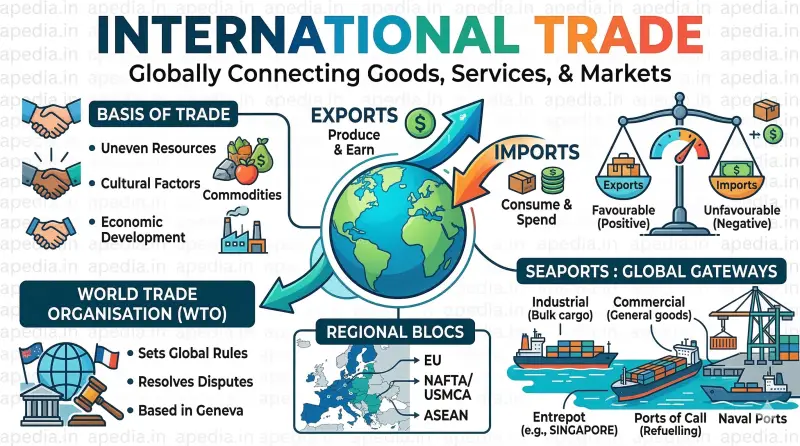
- National Resources: Uneven distribution of geology, minerals, and climate across the world dictates what a country can produce[cite: 2379, 2380].
- Population Factors: Cultural distinctions (like Chinese porcelain or Iranian carpets) and the size/standard of living of a population affect trade volume and demand[cite: 2387, 2388, 2390].
- Economic Development & Investment: The stage of a country's economy dictates its export items (agricultural vs. industrial), while foreign investment boosts capital-intensive sectors in developing nations[cite: 2395, 2397].
- Transport: Expansions in rail, ocean, and air networks, along with refrigeration, have spatially expanded global trade[cite: 2402].
📝 Concept Check 1
1. What was the 6,000 km ancient route connecting Rome to China called?
The Silk Route
2. What economic system involves the direct exchange of goods without money?
Barter System
3. Which factor explains why tropical regions export bananas and cold regions produce wool?
Differences in Climate
4. Does a densely populated country typically have a large or small volume of external trade?
Small, because most production is consumed locally.
⚖️ Module 2: Trade Dynamics & The WTO
The health of a nation's trade is measured by its Balance of Trade—the volume of goods and services imported versus exported[cite: 2405]. A favourable (positive) balance means exports exceed imports, while an unfavourable (negative) balance means a country spends more on buying goods than it earns, leading to exhausted financial reserves[cite: 2406, 2407, 2409].
Trade Liberalisation and Organizations
- Free Trade & Dumping: Opening economies by bringing down tariffs is called trade liberalisation[cite: 2428]. However, countries must be cautious of dumping, which is the practice of selling a commodity in two countries at different prices for reasons not related to costs, often harming domestic producers[cite: 2418, 2420].
- World Trade Organisation (WTO): Formed on January 1, 1995, transforming from the earlier GATT (General Agreement for Tariffs and Trade)[cite: 2444]. Headquartered in Geneva, it sets global trade rules and resolves disputes[cite: 2445, 2455]. Critics argue the WTO often favors rich countries and ignores environmental and labor rights[cite: 2451, 2453].
- Regional Trade Blocs: Formed to encourage trade among geographically proximate countries and to curb external restrictions. Today, 120 regional blocs generate 52% of world trade[cite: 2458, 2459].
⚓ Module 3: Gateways of Trade (Ports)
Harbours and ports serve as the chief gateways of international trade, providing facilities for docking, loading, unloading, and storage[cite: 2473, 2475]. The volume of cargo handled by a port is a strong indicator of its hinterland's development[cite: 2478].
Classification of Ports
- Based on Cargo: Industrial Ports (specialize in bulk cargo like grain, ore, oil)[cite: 2485, 2486]; Commercial Ports (handle general packaged cargo and passengers)[cite: 2487]; Comprehensive Ports (handle both bulk and general cargo in large volumes)[cite: 2489].
- Based on Location: Inland Ports (located away from the sea, linked by rivers/canals, e.g., Manchester, Kolkata)[cite: 2491, 2492, 2495]; Out Ports (deep water ports built away from parent ports to receive massive ships, e.g., Piraeus for Athens)[cite: 2496, 2498].
- Based on Specialised Functions:
- Oil Ports: Tankers or refineries (e.g., Maracaibo, Abadan)[cite: 2500, 2502].
- Ports of Call: Developed as anchoring points for refuelling and watering (e.g., Aden, Honolulu)[cite: 2507, 2508].
- Packet Stations (Ferry Ports): Exclusively for passengers and mail across short water bodies (e.g., Dover and Calais)[cite: 2509, 2510].
- Entrepot Ports: Collection centers where goods are brought for export to other countries (e.g., Singapore, Rotterdam)[cite: 2512, 2513].
- Naval Ports: Strategic ports for warships and repair (e.g., Kochi, Karwar)[cite: 2514, 2515].
📝 Concept Check 2
1. What indicates a negative balance of trade?
When the value of imports is greater than exports.
2. What institution replaced GATT on January 1, 1995?
World Trade Organisation (WTO)
3. Which type of port serves as a collection center to redistribute goods to other countries?
Entrepot Port
4. Kolkata and Memphis are examples of which type of port based on location?
Inland Ports