👑 Kings, Farmers and Towns
📜 Module 1: Epigraphy and the Earliest States
Between the 6th century BCE and the 6th century CE, the Indian subcontinent underwent profound shifts in its political and economic landscape. Historians rely heavily on epigraphy—the analytical study of ancient inscriptions—to decode this transformative era.
Decipherment and the Mahajanapadas
- Decoding the Past: A monumental leap in Indian historiography occurred in the 1830s when James Prinsep, an official of the East India Company, successfully cracked the ancient Brahmi and Kharosthi scripts. His translation work revealed frequent references to a monarch titled "Piyadassi" (translating to "pleasant to behold"), which scholars later identified as the great Emperor Ashoka.
- The Sixteen States: The 6th century BCE represents a pivotal epoch characterized by the widespread adoption of iron tools, the introduction of early currency, and the formation of complex state structures. These developments culminated in the rise of sixteen prominent oligarchies and monarchies known as the mahajanapadas, with notable powers including Gandhara, Koshala, Kuru, Vajji, Panchala, Avanti, and Magadha.
- Magadhan Supremacy: Over two centuries, Magadha (situated in modern Bihar) consolidated its position as the dominant mahajanapada. Its rapid ascent to power was fueled by immense agricultural wealth, strategic access to iron ore deposits in what is now Jharkhand, the military advantage of war elephants, and the utilization of the Ganga river network for highly efficient trade and transport.
- Strategic Relocation: Initially, the Magadhan rulers operated from Rajagaha (literally "the king's house"), a heavily fortified city nestled in a hilly terrain. However, to better control the vital riverine trade routes, the capital was relocated to Pataliputra during the 4th century BCE.
📝 Concept Check 1
1. Which East India Company official successfully deciphered the Brahmi and Kharosthi scripts?
James Prinsep.
2. What is the English translation of the royal epithet "Piyadassi"?
"Pleasant to behold".
3. Ancient Buddhist and Jaina texts frequently reference how many major early states?
Sixteen (the mahajanapadas).
4. What was the name of the heavily fortified, hill-bound first capital of Magadha?
Rajagaha.
🐘 Module 2: The Mauryan Empire and New Kingships
The territorial expansion of Magadha ultimately paved the way for the mighty Mauryan Empire. As this vast empire eventually fragmented, it was replaced by regional dynasties that introduced novel concepts of royal divinity and administration.
The Mauryas and Their Successors
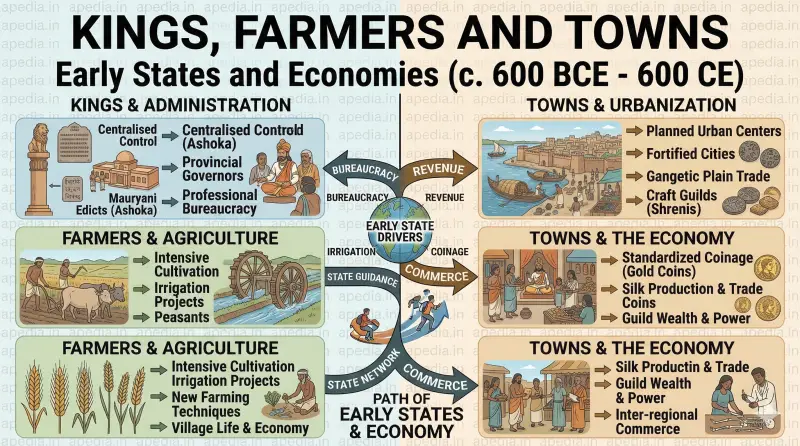
- The Mauryan Dynasty: Established around 321 BCE by Chandragupta Maurya, the empire's borders were aggressively pushed outward to encompass regions of Baluchistan and Afghanistan. The dynasty reached its zenith under his grandson, Ashoka. Ashoka pioneered the use of stone edicts to communicate directly with his subjects, utilizing these monumental inscriptions to spread dhamma—a moral code emphasizing generosity towards ascetics and reverence for elders.
- Imperial Governance: The massive Mauryan state was administered through a central capital at Pataliputra and four critical regional hubs: Suvarnagiri, Tosali, Ujjayini, and Taxila. Our understanding of this complex bureaucracy is enriched by the surviving texts of the Arthashastra (attributed to the statesman Kautilya) and the detailed observations of the Greek envoy Megasthenes.
- The Cult of the King: Emerging around the 1st century BCE, the Kushana dynasty commanded a massive territory stretching from Central Asia down to northwestern India. To legitimize their absolute authority, Kushana monarchs erected giant portrait statues in dynastic shrines and assumed grandiose, god-like titles such as devaputra (meaning "son of god").
- The Gupta Era: Rising to prominence in the 4th century CE, the Gupta rulers relied heavily on a decentralized network of subordinate local lords known as samantas. Historians piece together the Gupta lineage through numismatics, literary works, and glowing poetic tributes called prashastis. A prime example is the Prayaga Prashasti, a majestic eulogy composed by the court poet Harishena to glorify Emperor Samudragupta.
📝 Concept Check 2
1. Who is credited with founding the vast Mauryan Empire in the 4th century BCE?
Chandragupta Maurya.
2. What ideological framework did Emperor Ashoka promote through his famous rock edicts?
Dhamma.
3. Which ancient dynasty asserted their divine right to rule by adopting the title 'devaputra'?
The Kushanas.
4. Which court poet authored the glowing panegyric known as the Prayaga Prashasti?
Harishena.
🌾 Module 3: The Countryside, Towns, and Trade
Beyond the royal courts, profound socio-economic shifts were occurring at the grassroots level. Innovations in farming practices stimulated urban growth, expanded commercial trade routes, and simultaneously widened the wealth gap within rural communities.
Agriculture, Society, and Coinage
- Agrarian Innovations: Facing mounting taxation pressures from the state, cultivators in the lush Kaveri and Ganga river basins adopted the iron-tipped plow, drastically improving soil turnover. Additionally, agricultural yields in specific regions of the Ganga valley skyrocketed due to the labor-intensive but highly rewarding practice of paddy transplantation.
- Social Stratification: This agricultural boom unequally distributed wealth, creating distinct social hierarchies in villages. Ancient Buddhist literature frequently references the gahapati—a powerful household head or affluent landowner who wielded significant local influence. Furthermore, royal land grants (known as agrahara) became a prominent socio-political tool. While women were generally excluded from property ownership, historical records highlight the extraordinary case of the Vakataka queen Prabhavati Gupta (Chandragupta II's daughter), who independently held and donated vast estates.
- Urban Economics: The revival of urban centers fostered a bustling class of merchants and craftspeople. To protect their economic interests, these artisans organized into highly structured guilds or shrenis, which managed the supply of raw materials and strictly regulated the quality of manufactured goods.
- Commerce and Currency: Expanding trade networks connected the subcontinent across the Bay of Bengal and the Arabian Sea. To facilitate this vast commerce, early metallic currency emerged around the 6th century BCE in the form of silver and copper punch-marked coins. The monetary system later evolved significantly: the Kushana dynasty holds the distinction of minting the subcontinent's earliest gold coins, while the subsequent Gupta Empire became renowned for producing exceptionally pure, intricately designed gold currency.
📝 Concept Check 3
1. What labor-intensive agricultural method was adopted in the Ganga valley to maximize crop yields?
Paddy transplantation.
2. What specific term did early Buddhist literature use to describe a wealthy rural landowner?
Gahapati.
3. Name the prominent Vakataka queen who broke tradition by independently owning and issuing land grants.
Prabhavati Gupta.
4. Which ancient Indian empire is credited with issuing the very first gold currency?
The Kushanas.