📜 Kinship, Caste and Class: Early Societies
🏛️ Module 1: The Mahabharata, Kinship, and Marriage
To decode the social fabric of early India (c. 600 BCE – 600 CE), scholars dive deep into ancient literary traditions. The monumental epic, the Mahabharata, serves as a crucial lens through which we can observe the complex family dynamics and social expectations of the era.
Reconstructing Ancient Social Norms
- The Critical Edition: Understanding such a massive text required unprecedented scholarly collaboration. In 1919, the eminent Sanskritist V.S. Sukthankar launched an ambitious project to compile a definitive "critical edition" of the Mahabharata. By comparing thousands of surviving manuscripts from across the subcontinent, the team took 47 years to distill the epic to its core verses.
- Patriarchal Succession: At its heart, the Mahabharata revolves around a devastating familial conflict over royal succession between the Pandavas and Kauravas. This narrative heavily reinforces the concept of patriliny—a system where wealth, land, and royal titles are inherited strictly through the male bloodline.
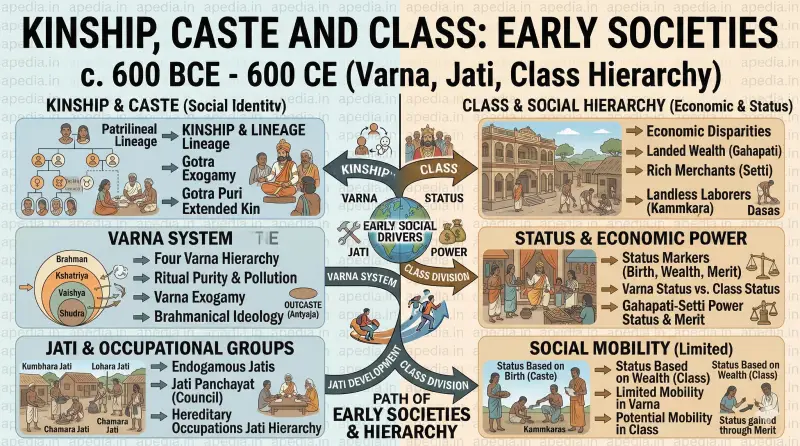
- Matrimonial Codes: Normative texts like the Dharmasutras strictly regulated marriage. While they identified eight distinct types of unions, only the first four were deemed socially acceptable by Brahmanical standards. Exogamy (marrying outside of one's immediate kinship group) was highly encouraged to forge broader political and social alliances.
- The Lineage System: Around 1000 BCE, Brahmanical authorities formalized the gotra system, tracing lineages back to revered Vedic sages. The rules dictated that a woman must surrender her father's gotra and adopt her husband's upon marriage, and that individuals sharing a gotra were forbidden from marrying. However, historical evidence shows that powerful Deccan dynasties, such as the Satavahanas, frequently ignored these mandates by practicing endogamy (marrying within close kin networks) and allowing queens to retain their maiden matronymics.
📝 Concept Check 1
1. Which Sanskrit scholar spearheaded the 47-year project to compile the critical edition of the Mahabharata?
V.S. Sukthankar.
2. What historical system of inheritance traces descent exclusively through the male line?
Patriliny.
3. According to strict Brahmanical norms, what was expected of a woman's lineage identity upon marriage?
She was expected to abandon her father's gotra and assume the gotra of her husband.
4. Which prominent dynasty openly defied Brahmanical rules by practicing endogamy and using matronymics?
The Satavahanas.
⚖️ Module 2: Varna, Jati, and Beyond
Orthodox texts attempted to organize society into a rigid, divinely ordained four-tier hierarchy known as the Varna system. However, historical records reveal a much more fluid and complex reality on the ground.
Social Stratification and its Exceptions
- The Theoretical Hierarchy: The Dharmashastras assigned rigid societal roles: Brahmanas were tasked with religious rituals and textual study, Kshatriyas were designated as warriors and administrators, Vaishyas managed trade and agriculture, and Shudras were relegated to serving the upper tiers.
- Kingship Beyond Kshatriyas: Despite textual claims that only Kshatriyas could rule, history proves otherwise. The origins of the Mauryas remain debated, while the subsequent Shunga and Kanva dynasties were undeniably Brahmana. Furthermore, the Satavahana monarch Gotami-puta Siri-Satakani proudly identified as a Brahmana who crushed Kshatriya arrogance. Migrant rulers from Central Asia, like the Shakas, successfully seized power despite being labeled mlechchhas (outsiders or barbarians) by orthodox elites.
- The Fluidity of Jati: While there were only four fixed Varnas, society birthed an endless number of jatis. Any occupational group or isolated community that fell outside the standard four-tier system (such as forest-dwelling tribes or specialized artisans) was categorized as a distinct jati. Over time, jatis sharing a profession often organized into powerful economic guilds, known as shrenis.
- Social Exclusion: The hierarchy also created extreme forms of marginalization. Groups tasked with "polluting" duties, such as handling corpses, were classified as "untouchables" (e.g., the Chandalas) and forced to live outside village boundaries. Accounts from visiting Chinese monks, such as Fa Xian and Xuan Zang, vividly document the severe social segregation these marginalized groups endured.
📝 Concept Check 2
1. Within the theoretical Varna framework, which group was exclusively assigned the duties of warfare and governance?
The Kshatriyas.
2. What derogatory term did Brahmanical texts use to describe foreign rulers like the Central Asian Shakas?
Mlechchhas (meaning barbarians or outsiders).
3. How did the concept of 'Jati' differ fundamentally from the concept of 'Varna'?
Varnas were strictly limited to four categories, whereas the number of Jatis was unrestricted and constantly expanding.
4. Which visiting Chinese pilgrim documented the harsh reality that "untouchables" were forced to sound a clapper to announce their presence?
Fa Xian.
💰 Module 3: Gender, Wealth, and Alternatives
Economic disparities deeply fractured early Indian society along the lines of both gender and caste. This severe inequality eventually triggered the rise of alternative philosophical movements, most notably Buddhism, which challenged the orthodox status quo.
Economic Disparities and Philosophical Challenges
- Property and Patriarchy: Inheritance laws, particularly those codified in the Manusmriti, heavily favored men. A father's wealth was distributed among his sons, with a premium share often reserved for the eldest. Women were legally barred from claiming paternal property. Their only recognized financial security was stridhana—gifts accumulated during marriage—which they retained control over and could pass to their offspring.
- Caste and Capital: Brahmanical literature reinforced the idea that wealth accumulation was a privilege of the upper echelons (Brahmanas and Kshatriyas). Because Shudras were restricted to servitude, the texts structurally denied them avenues for economic advancement.
- The Buddhist Pushback: Early Buddhism emerged as a powerful counter-narrative to Brahmanical dominance. While Buddhists acknowledged that societal inequalities existed, they fiercely rejected the notion that these differences were divine or immutable. They argued that a person's worth should be judged by their actions, not their birthright.
- A Humanist View of Kingship: Buddhist texts offered a radically different origin story for societal structure. The Sutta Pitaka describes a mythological evolution where human greed disrupted an initially peaceful world. To restore order, the people collectively chose a leader—the mahasammata ("the great elect")—and compensated him with a portion of their harvest. This concept framed kingship as a human social contract rather than a divine mandate.
📝 Concept Check 3
1. Under the rules of the Manusmriti, who inherited the primary bulk of a father's estate?
The sons, often with the eldest receiving a special portion.
2. What specific term describes the personal wealth or bridal gifts a woman was legally allowed to retain?
Stridhana.
3. How did early Buddhist philosophy fundamentally disagree with the Brahmanical Varna system?
Buddhists denied that social stratification was divinely ordained or strictly tied to the circumstances of one's birth.
4. In Buddhist tradition, what does the title "mahasammata" signify regarding the origins of leadership?
It means "the great elect," indicating that early kingship was based on a mutual social contract rather than divine right.