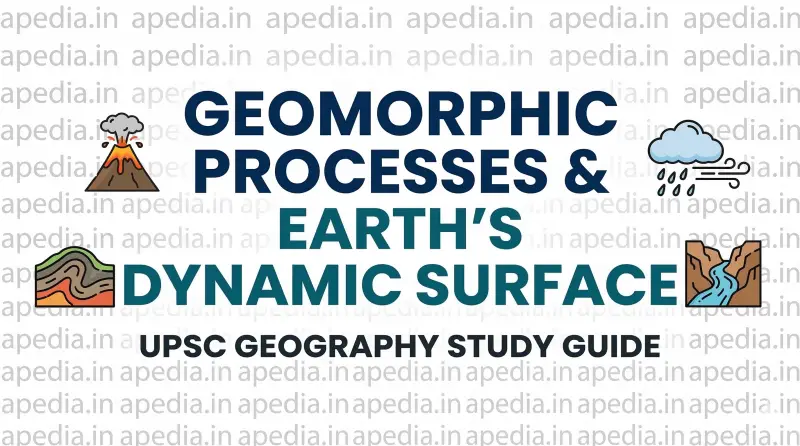
🌍 Earth's Dynamic Surface
🔥 Module 1: The Land Builders (Endogenic Forces)
The Earth's crust is continuously reshaped by deep-seated internal energy. The forces powered by this interior heat are categorized as Endogenic Processes, and they primarily serve to build up or elevate the planet's surface. This essential energy is generated by three main factors: primordial heat, tidal friction, and radioactivity.
Key Internal Mechanisms
- Diastrophism: A collective term for any geomorphic process that lifts, warps, or otherwise constructs portions of the Earth's crust.
- Orogeny: A specific type of diastrophism defined as a mountain-building event, characterized by the severe folding of the Earth's crust.
- Volcanism: The transportation of molten rock (magma) toward or entirely onto the exterior surface of the Earth.
📝 Concept Check 1
1. Which broad category of forces is responsible for elevating and building the Earth's surface?
Endogenic forces
2. Name two primary sources of internal energy that power tectonic movements.
Radioactivity and tidal friction
3. Among Volcanism, Orogeny, Diastrophism, and Weathering, which is NOT considered an internal process?
Weathering
4. The specific phenomenon of creating mountain ranges through intense crustal folding is called:
Orogeny
🌧️ Module 2: The Land Sculptors (Exogenic Forces)
In contrast to the land-building internal mechanisms, Exogenic Forces act as land-wearing elements driven ultimately by solar energy. The continuous reduction of surface irregularities through erosion is defined as Gradation. The comprehensive term for the stripping and uncovering of the landscape is Denudation.
1. Weathering (In-Situ Breakdown)
Weathering involves the mechanical breakdown or chemical decay of rock structures. Because the material experiences virtually no displacement during this phase, weathering is designated as an in-situ (on-site) process.
- Chemical Weathering: The decomposition of minerals through reactions such as carbonation, hydration, and oxidation.
- Physical Weathering: Fracturing driven by applied forces such as thermal expansion. The release of pressure, or unloading, can cause outer rock layers to peel away, forming rounded exfoliation domes.
- Biological Weathering: The physical shifting and chemical alteration caused by organisms. Burrowing animals like earthworms and termites expose underlying bedrock to the elements.
📝 Concept Check 2
1. What specific term describes the erosional wearing down of the Earth's relief variations?
Gradation
2. Which general umbrella term covers all external processes that strip away the Earth's surface?
Denudation
3. What does the root word "denude" literally signify?
To strip off or uncover
4. Due to the lack of motion involved, how is the weathering process classified geographically?
In-situ or on-site
5. Which of the following is a chemical weathering reaction?
Carbonation
6. Exfoliation domes are primarily created by which physical weathering mechanism?
Unloading
7. Name two organisms that contribute to biological weathering through their burrowing activities.
Earthworms and termites
⛰️ Module 3: Movement of Materials
1. Mass Movements
When rock debris shifts down a slope, it is classified as a mass movement. This action is directly governed by gravitational force. While prior weathering aids in loosening the material, it is not a mandatory prerequisite for mass movement to occur.
- Slump: The sliding of rock debris that is accompanied by a distinct backward rotation relative to the slope.
- Debris Slide: The rapid rolling or sliding of an earth mass that does not exhibit any backward rotation.
2. Erosion and Deposition
Erosion entails the acquisition and subsequent transportation of fragmented rock via dynamic agents like wind, running water, and glaciers. Once these agents lose their kinetic energy on gentler slopes, the transported materials settle. This resulting aggradation process is known as Deposition.
📝 Concept Check 3
1. Which primary force dictates the downslope transfer of rock debris?
Gravity
2. What process significantly aids mass movements but is not strictly required for them to happen?
Weathering
3. What type of mass movement involves earth units slipping down a slope with a backward rotation?
Slump
4. What do you call a rapid slide of earth debris that occurs without any backward rotation?
Debris slide
5. The combined process of acquiring and transporting rock fragments is known as:
Erosion
6. Deposition occurs directly as a result of geomorphic agents losing what?
Velocity/Energy
🌱 Module 4: Pedogenesis (Soil Formation)
Soil is a highly dynamic medium shaped by biological, chemical, and physical activities. The formal scientific study of soil is referred to as Pedology. The complex process of soil formation relies on five foundational control factors.
The Five Controlling Factors
- 1. Topography (Passive): Governs exposure and drainage. Flat terrains tend to develop thicker soils, whereas steep inclines result in thin soil layers.
- 2. Time (Passive): The length of exposure dictates the ultimate maturation and horizon development of the soil profile.
- 3. Parent Material (Passive): The source material, consisting of either transported deposits or in-situ weathered debris.
- 4. Climate (Active): A critical active driver. In wet equatorial regions, high rainfall flushes silica from the soil in a process known as desilication. Downward transportation of soil components by water is called eluviation. In arid zones, high evaporation brings salts to the surface via capillary action, forming crusts known as hardpans.
- 5. Biological Activity (Active): Organisms add vital elements to the soil. In freezing climates, bacterial growth is incredibly slow, resulting in the heavy accumulation of undecomposed humus. Conversely, beneficial bacteria like Rhizobium colonize legume root nodules to perform essential nitrogen fixation.
📝 Concept Check 4
1. What is the specific term used to describe soil science?
Pedology
2. Out of Climate, Biological Activity, and Topography, which is considered a passive soil-forming factor?
Topography
3. Heavy rainfall in tropical environments can wash away a major part of silica. What is this process called?
Desilication
4. When evaporation forces groundwater to the surface, it leaves behind salt crusts commonly known as:
Hardpans
5. What is the geographic term for the downward transportation of soil components via excess water?
Eluviation
6. Name the type of bacteria found in the root nodules of leguminous plants that aids in nitrogen fixation.
Rhizobium
7. Why do layers of undecomposed organic matter accumulate in tundra climates?
Bacterial growth is slow
8. The length of time that soil-forming processes operate determines what aspect of the soil?
Maturation and profile development