🐎 Nomadic Empires
🏕️ Module 1: The Mongols and their Habitat
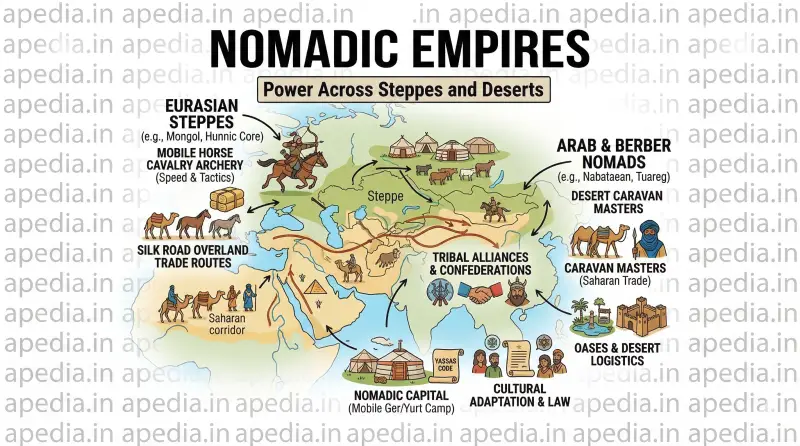
The Mongols were a diverse group of people linked by language to the Tatars, Khitan, and Turkic tribes. They inhabited the steppes of Central Asia, a region of wide horizons, rolling plains, and extreme temperatures.
Society and Economy
- Pastoralists and Hunters: Some Mongols were pastoralists tending horses, sheep, and camels, while others in the northern Siberian forests were hunter-gatherers making a living from the fur trade.
- Living Conditions: They lived in tents called gers and possessed no cities, moving with their herds between winter and summer pastures. Society was divided into patrilineal lineages, and periodic droughts often led to conflict over pasture lands.
- Relations with China: The scant resources of the steppe drove nomads to trade with their sedentary neighbors in China, exchanging horses and furs for agricultural produce and iron utensils. This relationship was tense; nomads often resorted to plunder, prompting Chinese regimes to build the 'Great Wall of China' for protection.
📝 Concept Check 1
1. What type of dwellings did the nomadic Mongols live in?
Tents called gers.
2. Why did the Mongols trade with China?
To obtain agricultural produce and iron utensils in exchange for horses and furs.
3. What structure was built by the Chinese to protect against nomadic raids?
The Great Wall of China.
⚔️ Module 2: The Career of Genghis Khan
Born around 1162, Temujin (later Genghis Khan) overcame early hardships, enslavement, and the kidnapping of his wife to unite the Mongol tribes.
Rise to Power and Conquests
- Alliances: He made crucial alliances with his blood-brother (anda) Jamuqa and his father's blood-brother, Ong Khan. Through the 1180s and 1190s, he defeated powerful adversaries, including the Tatars and eventually Jamuqa himself.
- The Universal Ruler: In 1206, at an assembly of Mongol chieftains (quriltai), Temujin was proclaimed the 'Great Khan of the Mongols' with the title Genghis Khan ('Oceanic Khan' or 'Universal Ruler').
- Campaigns: He breached the Great Wall of China in 1213 and sacked Peking in 1215. When Sultan Muhammad of Khwarazm executed Mongol envoys, Genghis Khan unleashed his fury, devastating cities like Bukhara, Samarqand, and Nishapur between 1219 and 1221. The scale of massacres in resisting cities was unprecedented.
🛡️ Module 3: Military Organization and Administration
Genghis Khan transformed steppe combat into an incredibly effective military strategy, uniting diverse tribes into a disciplined machine.
The Mongol War Machine
- The Decimal System: He systematically erased old tribal identities by reorganizing his army into decimal units of 10s, 100s, 1,000s, and 10,000 soldiers (called a tuman). Moving outside one's allotted group without permission was harshly punished.
- The Courier System (Yam): He fashioned a rapid courier system connecting his vast regime. Nomads willingly paid a levy called the qubcur tax (a tenth of their herd) to provision these outposts.
- The Four Ulus: He assigned the responsibility of governing the newly conquered people to his four sons (Jochi, Chaghatai, Ogodei, and Toluy), forming four ulus (territorial dominions).
📝 Concept Check 2
1. What was the name of the assembly where Temujin was proclaimed Genghis Khan?
The quriltai.
2. What was a 'tuman'?
The largest military unit, approximating 10,000 soldiers.
3. What tax did nomads pay to support the yam (courier) system?
The qubcur tax.
📜 Module 4: Legacy, Yasa, and the Pax Mongolica
Following Genghis Khan's death in 1227, the Mongol Empire eventually stabilized, leading to a period of unprecedented global integration.
Trade and Transformation
- Pax Mongolica: As peace was ushered in, trade connections matured, and commerce along the Silk Route reached its peak, connecting Europe and China. Travellers were given a safe-conduct pass (paiza/gerege).
- Sedentarization: The Mongol leadership eventually transitioned from pillaging to protecting sedentary populations. Rulers like Qubilai Khan and Ghazan Khan actively protected peasants and cities, realizing it was necessary for a prosperous realm.
- The Yasa: Originally referring to administrative regulations decreed at the 1206 quriltai, the yasa eventually evolved into the 'legal code of Genghis Khan'. For the Mongols—who were a minority ruling over sophisticated civilizations—the yasa served as an empowering ideology and sacred law that protected their distinct ethnic identity.