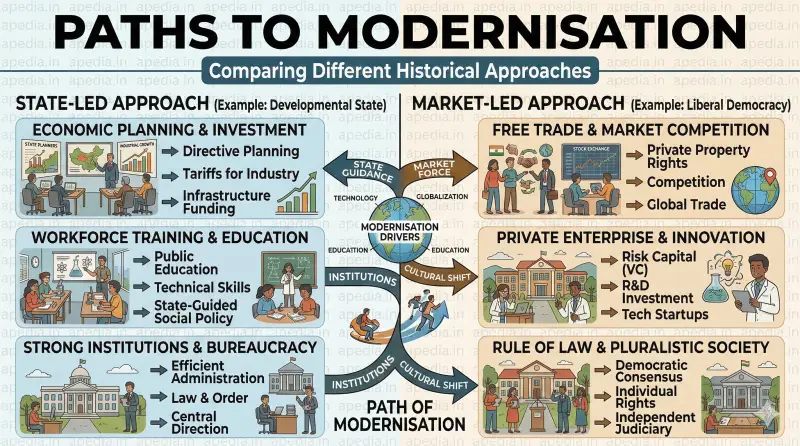
🛤️ Paths to Modernisation
🇯🇵 Module 1: Japan's Transformation and the Meiji Restoration
Entering the 19th century, the massive Qing Empire of China and the isolated island nation of Japan faced identical pressures from encroaching Western powers. However, their strategic responses and subsequent national trajectories could not have been more different.
From Shogunate to Empire
- The Tokugawa Era: For over two centuries (1603–1867), political power in Japan rested with the Tokugawa shogunate based in Edo (now Tokyo), relegating the Kyoto-based emperor to a symbolic role. The realm was administered through regional domains governed by feudal lords (daimyo) and defended by a samurai warrior class.
- Gunboat Diplomacy: Japan's centuries of deliberate isolation ended abruptly in 1853 when U.S. Commodore Matthew Perry's naval squadron forced the country to engage in international trade and diplomacy.
- The Meiji Restoration (1868): The shogunate collapsed under the weight of these foreign pressures. Power returned to Emperor Meiji, the capital relocated to Tokyo, and the state adopted a rapid modernization doctrine: fukoku kyohei (rich country, strong military).
- Industrial and Social Overhaul: To compete globally, the Meiji administration dismantled the feudal system, instituted a conscripted national army, and mandated public schooling to foster national loyalty. This rapid industrial growth was financially anchored by massive corporate monopolies known as zaibatsu.
📝 Concept Check 1
1. Which U.S. naval officer compelled Japan to abandon its isolationist policies in 1853?
Commodore Matthew Perry.
2. What is the translation of the Meiji-era reform motto, "fukoku kyohei"?
Rich country, strong army.
3. By what term were the massive industrial monopolies in Imperial Japan known?
Zaibatsu.
🇨🇳 Module 2: The Fall of Imperial China and the Republic
While Japan successfully modernized and expanded its own empire, China endured a century of profound crisis marked by foreign economic exploitation, internal rebellion, and political collapse.
Crisis and Revolution
- The Opium Wars: The Qing Empire faced catastrophic weakening in the 19th century following the Opium Wars. Triggered by the British East India Company's aggressive narcotic trade, these conflicts forced China to sign humiliating treaties that surrendered sovereignty and territory.
- Birth of a Republic: By 1911, revolutionaries successfully dismantled the imperial system. Sun Yat-sen emerged as the philosophical founder of the new republic, advocating for the "Three Principles" (San min chui): Nationalism, Democracy, and Socialism.
- The May Fourth Movement: Post-WWI frustrations over Western nations granting Chinese territories to Japan ignited massive anti-imperialist student demonstrations in 1919. This intellectual awakening demanded a culturally and scientifically modernized China.
- The Nationalist Struggle: Chiang Kai-shek assumed leadership of Sun Yat-sen's Guomindang (Nationalist Party) and launched military expeditions to unify the fractured republic, though his administration critically neglected the growing agrarian crisis.
⭐ Module 3: The Rise of the Chinese Communist Party
The Guomindang's failure to address severe rural poverty created fertile ground for the Chinese Communist Party (CCP), which was officially founded in 1921.
Mao Zedong and the PRC
- An Agrarian Approach: Breaking from orthodox European Marxists who focused on urban factory workers, Mao Zedong uniquely anchored his revolution in China's vast rural peasantry.
- The Long March (1934-35): To escape total annihilation by Nationalist forces, the CCP embarked on a grueling 6,000-mile strategic retreat to Yan'an, an event that forged the party's core leadership and mythology.
- Victory and the PRC: Following the defeat of the Japanese in WWII, the CCP triumphed in the ensuing civil war, forcing the Nationalists to flee to Taiwan. Mao officially established the People's Republic of China in 1949.
- Radical Campaigns: Mao's aggressive pushes for rapid transformation—such as the communal farming experiments of the "Great Leap Forward" (1958) and the ideological purges of the "Cultural Revolution" (1965)—resulted in catastrophic famine and deep social trauma.
- Deng Xiaoping's Pivot: Following Mao's death, Deng Xiaoping engineered a massive economic shift in 1978. His "Four Modernisations" opened China to global market forces, sparking unprecedented economic growth while violently preserving the CCP's absolute political monopoly, as demonstrated by the 1989 Tiananmen Square response.
📝 Concept Check 2
1. Which three core tenets defined Sun Yat-sen's vision for a modern China?
Nationalism, Democracy, and Socialism.
2. Unlike orthodox European Marxists, which demographic did Mao Zedong rely on to build his revolutionary base?
Rural peasants.
3. Who orchestrated China's shift toward a socialist market economy beginning in 1978?
Deng Xiaoping.
🇰🇷 Module 4: The Story of Korea and Post-War Japan
Alongside its larger neighbors, the Korean peninsula navigated a tumultuous 20th-century path from violent colonization to Cold War division, ultimately achieving remarkable economic success.
Korea's Division and Growth
- Colonial Rule: The historic Joseon Dynasty fell when Imperial Japan annexed Korea in 1910. The occupation was brutal, sparking fierce national resistance movements, most notably the March First Movement of 1919.
- A Fractured Peninsula: Post-WWII geopolitics split the nation at the 38th parallel. This division was cemented in blood during the Korean War (1950-53), permanently separating the communist North from the capitalist South.
- The Miracle on the Han River: South Korea underwent a period of hyper-accelerated, export-driven industrialization under the authoritarian regime of Park Chung-hee. This economic miracle eventually gave way to political freedom, with mass civic protests in 1987 securing a transition to a robust democracy.
Post-War Japan
- Democratic Reconstruction: A defeated and devastated Japan underwent structural transformation under U.S. occupation led by General MacArthur. The nation adopted a new democratic constitution featuring Article 9, which permanently renounced warfare.
- Economic Rebirth: Capitalizing on global trade integration and the manufacturing boom created by the nearby Korean War, Japan orchestrated a stunning economic recovery. Milestones like the rollout of the Shinkansen (bullet trains) and the hosting of the 1964 Tokyo Olympics signaled Japan's peaceful return as a global technological powerhouse.