🏛️ Political Theory: An Introduction
🤔 Module 1: What is Politics?
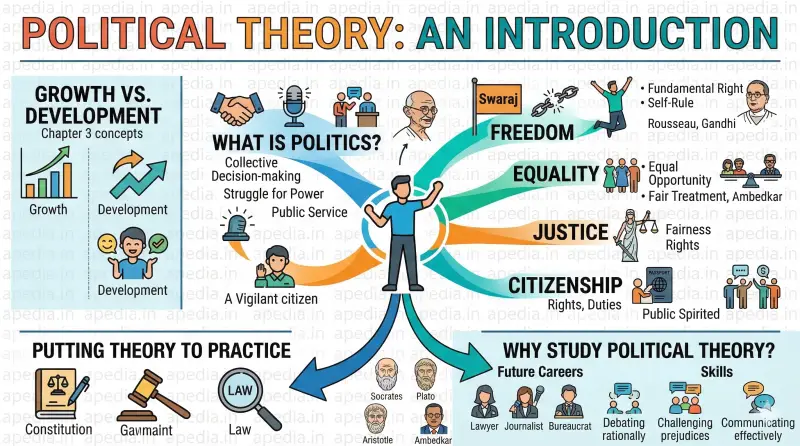
Human beings are unique because they possess reason, the ability to reflect, and the capacity to use language to communicate ideas about what is good and desirable. Political theory stems from these traits. However, people often have conflicting views on what "politics" actually is. While some see it as public service, others associate it with manipulation, self-interest, or "scams".
Despite this disillusionment, politics is an integral part of any society. Mahatma Gandhi famously observed that politics envelops us like the coils of a snake and there is no other way out but to wrestle with it. Politics arises from our different visions of what is just and involves the multiple negotiations through which collective decisions are made. It is not just about the government; it encompasses how citizens struggle, protest, negotiate, and influence decision-making to shape their world.
Despite this disillusionment, politics is an integral part of any society. Mahatma Gandhi famously observed that politics envelops us like the coils of a snake and there is no other way out but to wrestle with it. Politics arises from our different visions of what is just and involves the multiple negotiations through which collective decisions are made. It is not just about the government; it encompasses how citizens struggle, protest, negotiate, and influence decision-making to shape their world.
📝 Concept Check 1
1. What two unique human traits form the roots of political theory?
Reason and the capacity to use language.
2. How did Mahatma Gandhi describe the inescapable nature of politics?
He said it envelops us like the coils of a snake.
3. Is politics exclusively about what the government does?
No, it involves multiple negotiations in society and how people influence decisions.
4. What is the fundamental cause of politics?
The fact that people have different visions of what is just and desirable.
📚 Module 2: What Do We Study in Political Theory?
Political theory systematically examines values like freedom, equality, and justice that inform political life. It looks at the ideas of great thinkers: Plato and Aristotle debated monarchy vs. democracy; Jean-Jacques Rousseau argued for freedom as a fundamental right; Karl Marx asserted that equality is as crucial as freedom; Mahatma Gandhi discussed genuine freedom (swaraj); and Dr. B.R. Ambedkar vigorously argued for the special protection of scheduled castes as a minority.
These historical ideas directly shape modern constitutions. The Indian Constitution enshrines freedom and equality, abolishes untouchability, and incorporates Gandhian principles in its Directive Principles. Political theory also reflects on current experiences, addressing new threats like the need for internet regulation to protect privacy in global communications.
These historical ideas directly shape modern constitutions. The Indian Constitution enshrines freedom and equality, abolishes untouchability, and incorporates Gandhian principles in its Directive Principles. Political theory also reflects on current experiences, addressing new threats like the need for internet regulation to protect privacy in global communications.
⚙️ Module 3: Putting Theory to Practice & Why We Study It
Unlike mathematics, where a triangle has one fixed definition, political concepts like equality or freedom have diverse meanings depending on the context. For instance, equality might mean "equal opportunity" when waiting in a queue, but it also means providing "special treatment" or proactive measures for the poor and disabled who are disadvantaged.
Why Study Political Theory?
- Future Careers: It builds foundational knowledge for future politicians, lawyers, judges, journalists, and bureaucrats.
- Vigilant Citizenship: Just as musicians perform better for an educated audience, a vigilant and informed citizenry makes politicians more public-spirited.
- Challenging Prejudices: It encourages us to carefully examine our everyday prejudices and feelings about discrimination, making our ideas more moderate and reasonable.
- Effective Communication: It teaches us to debate rationally, defend our opinions, and communicate effectively, which are great assets in the modern informational order.
Historical Spotlight: In ancient Athens, Socrates was known for questioning popularly held beliefs, for which he was condemned to death. Through Plato's book, The Republic, we see Socrates using reason to reveal inconsistencies in people's views, proving that a truly "just" man should not harm or injure anyone, not even his enemies.
📝 Concept Check 2
1. Who wrote the book 'The Republic'?
Plato.
2. Why do political concepts like equality have multiple definitions?
Because their meaning is dependent on the context and involves human relationships.
3. How does an educated audience affect a musical performance, as compared to politics?
An educated audience makes musicians perform better, just as vigilant citizens make politicians more public-spirited.
4. According to Socrates, should a just man injure his enemies?
No, the just is the good and the good cannot harm anyone.