🌾 Primary Activities
🏹 Module 1: Hunting, Gathering, and Pastoralism
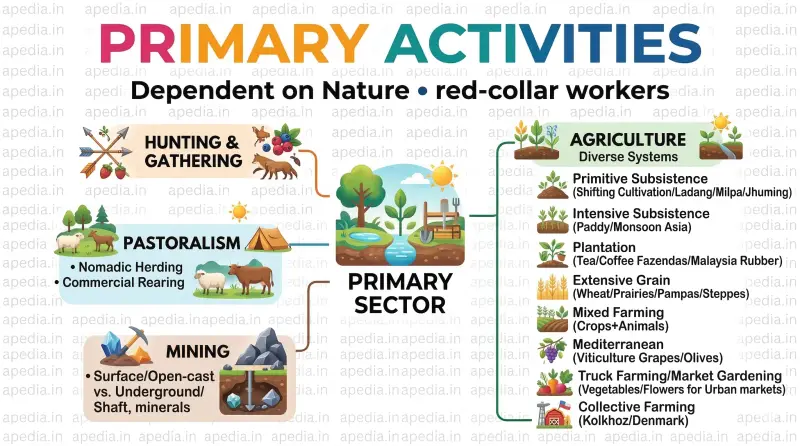
Primary activities are directly dependent on the environment as they refer to the utilisation of earth's resources like land, water, vegetation, building materials, and minerals. People engaged in these activities are often called "red-collar" workers due to the outdoor nature of their work.
Oldest Economic Activities
- Hunting and Gathering: The oldest known economic activities. Gathering is practiced in harsh climates (very cold or very hot), requires primitive tools, low capital, and yields low output. It is practiced in high-latitude zones (northern Canada, northern Eurasia) and low-latitude zones (Amazon Basin, Congo Basin).
- Nomadic Herding (Pastoral Nomadism): A primitive subsistence activity where herders rely entirely on their animals for food, clothing, and transport. They move from place to place following defined routes in search of pastures. The seasonal migration of herders between mountains and plains is called Transhumance (e.g., Gujjars and Bakarwals in the Himalayas).
- Commercial Livestock Rearing: Unlike nomadic herding, this is highly organized, capital-intensive, and practiced on permanent ranches. It focuses on a single type of animal (sheep, cattle, goats) for meat, wool, and dairy, heavily relying on scientific breeding and disease control (e.g., New Zealand, Australia, Argentina).
📝 Concept Check 1
1. What collar color is associated with primary activity workers?
Red-collar
2. What is the seasonal migration of pastoral nomads called?
Transhumance
3. Which type of livestock rearing is capital-intensive and uses permanent ranches?
Commercial Livestock Rearing
4. Where is gathering typically practiced?
In regions with harsh climates (high and low latitudes)
🌱 Module 2: Traditional and Subsistence Agriculture
Agriculture is the most widely distributed primary activity. Based on methods, scale, and crop types, it is classified into several systems.
Key Agricultural Systems
- Primitive Subsistence Agriculture: Also known as Shifting Cultivation or slash-and-burn agriculture. Vegetation is cleared by fire, and ashes add fertility. When fertility declines, farmers move to a new patch. It is called Jhuming in NE India, Milpa in Central America, and Ladang in Indonesia/Malaysia.
- Intensive Subsistence Agriculture: Found in densely populated monsoon regions of Asia. Land holdings are small, labor is intensive, and machinery use is low. It is divided into two types: dominated by wet paddy cultivation and dominated by crops other than paddy (wheat, soybean).
- Plantation Agriculture: Introduced by Europeans in their tropical colonies. It involves large estates, high capital investment, scientific methods, and specializes in a single cash crop like tea (India/Sri Lanka), coffee (Brazil's Fazendas), rubber (Malaysia), or sugarcane.
🚜 Module 3: Modern Agriculture and Mining
Modern primary activities heavily rely on technology, mechanization, and market demand.
Commercial Farming and Mining
- Extensive Commercial Grain Farming: Practiced in the interior semi-arid parts of mid-latitudes (Prairies, Pampas, Steppes, Downs). Wheat is the principal crop. Farms are massive and highly mechanized.
- Mixed Farming: Equal emphasis is laid on crop cultivation and animal husbandry. Practiced in highly developed parts of NW Europe and North America.
- Dairy Farming: The most advanced and efficient type of rearing milch animals. Highly capital-intensive (sheds, storage, feeding) and located near urban centers.
- Mediterranean Agriculture & Truck Farming: Mediterranean regions specialize in viticulture (grape cultivation), olives, and citrus fruits. Truck farming (Market Gardening) involves growing vegetables and flowers specifically for urban markets.
- Mining: The extraction of valuable minerals. Surface mining (open-cast) is cheap and close to the surface. Underground mining (shaft method) uses vertical shafts to reach deep minerals, which is risky and expensive.
📝 Concept Check 2
1. What is the cultivation of grapes specifically called?
Viticulture
2. Which farming involves growing vegetables specialized for urban markets?
Truck Farming / Market Gardening
3. What is the principal crop of extensive commercial grain farming?
Wheat
4. Which mining method is considered riskier and more expensive?
Underground / Shaft mining