📜 Rights
🛡️ Module 1: What Are Rights?
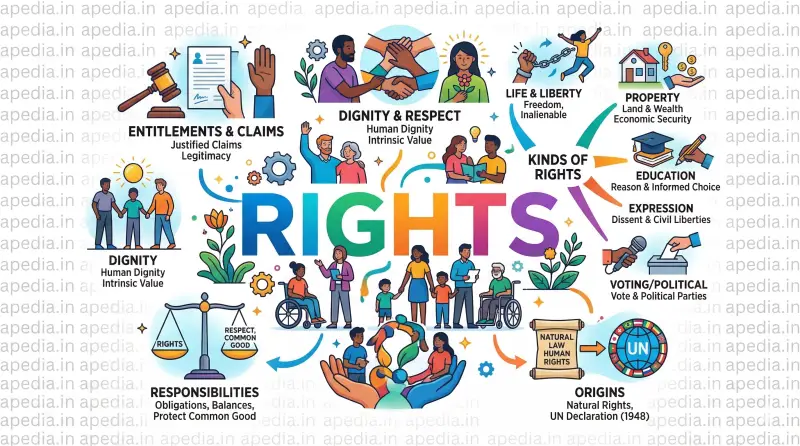
A right is essentially an entitlement or a justified claim. It denotes what we consider to be due to us as individuals and human beings, and it represents a claim that society must recognise as legitimate and uphold.
Rights vs. Desires
- Not all desires are rights: I may want to stay out late at night or wear whatever I want to school, but this does not mean I have a designated right to do so.
- Dignity and Well-being: Rights are claims that are necessary for leading a life of respect and dignity. For example, the right to livelihood gives a person economic independence, while the right to education develops our capacity to reason and make informed choices.
- Exclusions: Activities that are injurious to health and well-being, such as inhaling prohibited drugs or smoking tobacco, cannot be claimed as rights because they damage one's health and can be a danger to others.
📝 Concept Check 1
1. What is the basic definition of a right?
An entitlement or a justified claim
2. Are all personal desires considered rights?
No, there is a distinction between what we want and what can be designated as a right
3. Why is the right to education considered universal?
It develops our capacity to reason and enables us to make informed choices
4. Why isn't taking prohibited drugs considered a right?
Because it is injurious to our health and well-being
🌱 Module 2: The Origins of Rights
The understanding of where rights come from has evolved over centuries.
From Natural Law to Human Dignity
- Natural Rights: In the 17th and 18th centuries, political theorists argued that rights were given to us by nature or God. They identified three inalienable natural rights: the right to life, liberty, and property.
- Immanuel Kant on Human Dignity: The 18th-century German philosopher Immanuel Kant argued that while objects have a "price", human beings possess an intrinsic "dignity". Kant stated that humans should be treated morally and as valuable in themselves, not merely as useful means to an end.
- Modern Human Rights: Today, we use the term "human rights" instead of "natural rights". This shift is reflected in the UN Universal Declaration of Human Rights, adopted on 10 December 1948. New challenges have expanded this list to include rights to clean air, safe drinking water, and sustainable development.
⚖️ Module 3: Kinds of Rights and Responsibilities
While moral claims are important, rights require the support of governments and the law to be successful. Many countries enshrine these in their constitutions as a Bill of Rights (or Fundamental Rights in India).
Kinds of Rights
- Political Rights & Civil Liberties: Include the right to vote, contest elections, and form political parties. Civil liberties include a free and fair trial and the right to express dissent.
- Economic Rights: Political rights have little value to a starving person. Thus, democracies provide economic rights like a minimum wage, housing, medical facilities, or rural employment guarantees.
- Cultural Rights: The right to receive primary education in one's mother tongue and establish cultural institutions.
Our Responsibilities
Rights place obligations not only on the state but also on individuals:
- Protecting the Common Good: We must defend things good for all, like protecting the ozone layer and maintaining ecological balance.
- Respecting Others' Rights: If I demand the right to express my views, I must grant others the same right. I cannot use my free speech to incite a crowd to kill.
- Balancing Rights: My freedom of expression allows me to take photos, but posting a picture of someone bathing without their consent violates their right to privacy.
- Vigilance: Citizens must be vigilant against governments using "national security" as an excuse to impose authoritarian restrictions, arbitrary arrests, or torture.
📝 Concept Check 2
1. What were the three natural rights identified by early theorists?
Right to life, liberty, and property
2. Who argued that human beings possess intrinsic "dignity"?
Immanuel Kant
3. What is the constitutional document listing essential rights called in many countries?
A Bill of Rights
4. Does the right to free speech allow inciting violence?
No, exercising our rights must not deprive others of their rights