
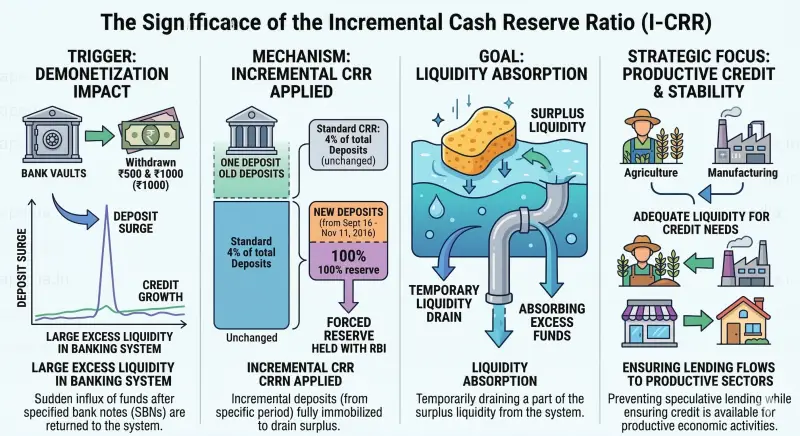
💧 Understanding the Surge in Liquidity and I-CRR
Following the withdrawal of ₹500 and ₹1,000 denomination banknotes in November 2016, Indian banks witnessed an unprecedented surge in deposits. However, this massive influx of funds was not matched by an equivalent expansion in bank credit, resulting in a massive pool of excess liquidity within the banking system. To stabilize the financial system and manage this temporary anomaly, the Reserve Bank of India (RBI) introduced an innovative tool: the Incremental Cash Reserve Ratio (I-CRR). While the standard CRR mandated banks to keep a fixed percentage of their total deposits with the RBI, the incremental CRR was specifically targeted at the sudden spike in deposits during a specific window, absorbing the surplus without disrupting regular credit flows to productive economic sectors.
💧 Key Initiatives & Strategic Focus
The RBI's deployment of the incremental CRR was carefully calibrated to drain excess funds while maintaining economic stability.
- Implemented as a purely temporary measure within the RBI's liquidity framework.
- Scheduled for a rapid review (by December 9, 2016) to assess market conditions.
- Supported by a revived Guarantee Scheme to help banks deposit specified bank notes directly at currency chests.