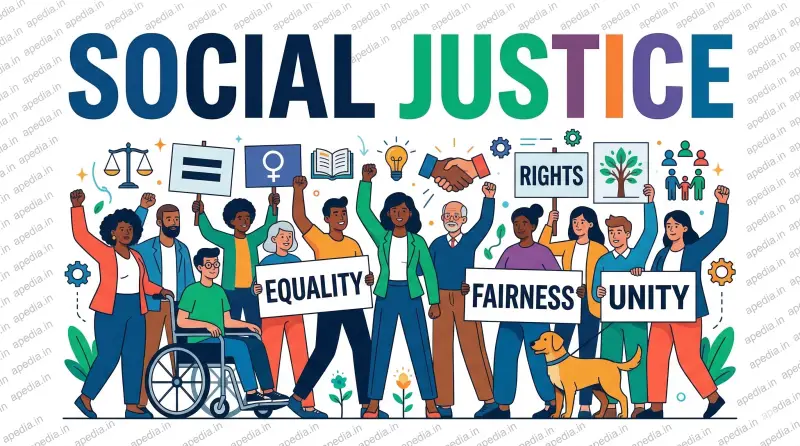
⚖️ Social Justice
🏛️ Module 1: What is Justice?
Justice concerns how public life is ordered and how social goods and duties are distributed among society's members. Throughout history, different cultures have interpreted this concept in unique ways:
- Ancient India: Justice was intimately associated with dharma, and maintaining a just social order was considered the primary duty of kings.
- Ancient China: The philosopher Confucius argued that kings maintain justice by rewarding the virtuous and punishing wrongdoers.
- Ancient Greece: In fourth century B.C. Athens, Plato explored justice in his book The Republic. Through a dialogue featuring Socrates, Glaucon, and Adeimantus, Socrates proved that a just society ensures the well-being of all people, just as a doctor ensures the well-being of patients.
- Modern Perspective: German philosopher Immanuel Kant asserted that all human beings possess dignity, meaning justice requires giving every person the opportunity to develop their talents and pursue their goals. Essentially, justice means giving each person their due.
📝 Concept Check 1
1. What did ancient Indian society associate justice with?
Dharma
2. Who wrote the famous book 'The Republic'?
Plato
3. Which philosopher argued that human beings possess dignity?
Immanuel Kant
4. What is the central idea of justice in modern times?
Giving each person their due and equal consideration
📏 Module 2: The Three Principles of Justice
Governments face the complex task of harmonizing different principles to promote a just society. These are the three main principles:
- 1. Equal Treatment for Equals: Because all individuals share characteristics as human beings, they deserve equal rights (civil, political, and social) and should not be discriminated against based on class, caste, race, or gender. If two people from different castes do the same work, they deserve the exact same reward.
- 2. Proportionate Justice: Treating everyone equally isn't always fair. Provided everyone starts with equal rights, justice also means rewarding people in proportion to the scale, quality, effort, and danger of their work. For example, miners or police officers in dangerous professions may justifiably earn different rewards based on the risks and skills involved.
- 3. Recognition of Special Needs: A just society must account for people's special needs to ensure true equality of opportunity. Factors like physical disabilities, age, or historical lack of access to education and health care (such as discrimination based on caste) are grounds for special treatment. The Indian Constitution's provision for reservations is an application of this principle.
⚖️ Module 3: Just Distribution & John Rawls
Social justice requires not just fair laws, but a just distribution of goods, services, and opportunities. The government has a responsibility to ensure basic minimum conditions for all citizens, such as nourishment, housing, clean water, education, and a minimum wage.
John Rawls and the "Veil of Ignorance"
To figure out how to organize a truly fair society, political philosopher John Rawls proposed the "veil of ignorance" thought experiment. He argued that if we had to design society's rules without knowing what position we would occupy in it (our class, caste, or wealth), we would naturally choose rules that are fair to everyone. Because we might end up being the poorest person, it is in our rational self-interest to ensure that the worst-off members have reasonable opportunities and basic resources. Rawls proves that fairness can be the outcome of rational action, rather than relying solely on morality or self-sacrifice.
Free Markets vs. State Intervention
There is an ongoing debate about how to distribute resources. Supporters of free markets argue that unregulated competition rewards merit and talent neutrally, without caring about caste or gender. However, critics point out that free markets naturally tend to favor those who are already wealthy and privileged. Therefore, state intervention is necessary to provide basic facilities, like rural schools and healthcare, because private businesses may ignore areas that aren't profitable.
📝 Concept Check 2
1. Rewarding a worker more because their job is highly dangerous falls under which principle?
Proportionate Justice
2. What thought experiment did John Rawls propose?
The Veil of Ignorance
3. According to Rawls, what drives people to choose fair rules under the veil of ignorance?
Rational self-interest, not morality
4. What is a major criticism of entirely free markets?
They tend to work in the interest of the strong, wealthy, and already privileged