
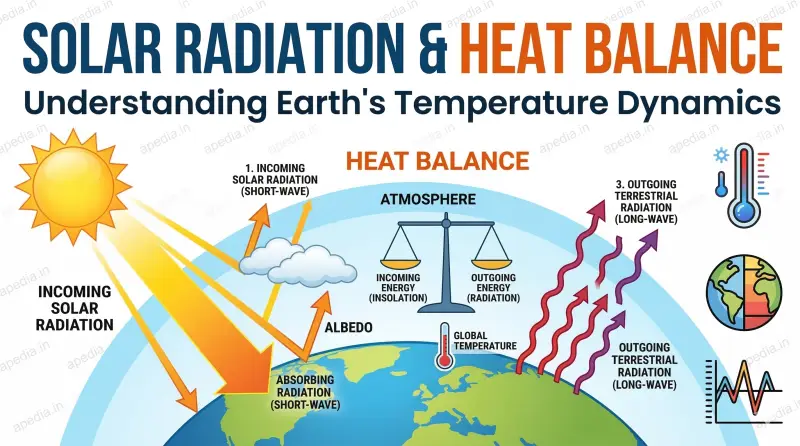
☀️ Solar Radiation, Heat Balance, and Temperature
📡 Module 1: Solar Radiation (Insolation)
The Earth receives almost all of its energy from the sun in the form of short wavelengths. This incoming solar radiation is known as insolation. Because Earth is a geoid, sun rays fall obliquely at the top of the atmosphere, and the amount received varies based on the Earth's position in its orbit.
Key Orbital Positions
- Aphelion: On 4th July, the Earth is farthest from the sun (152 million km).
- Perihelion: On 3rd January, the Earth is nearest to the sun (147 million km), receiving slightly more insolation.
- Factors Affecting Insolation: Variability is caused by the rotation of the Earth, the angle of inclination of the sun's rays, the length of the day, and atmospheric transparency.
📝 Concept Check 1
1. What is the term for incoming solar radiation?
Insolation
2. On what date is the Earth closest to the sun?
3rd January (Perihelion)
3. In what form does the Earth receive most of its energy?
Short wavelengths
4. What angle does the Earth's axis make with its orbit?
66.5 degrees
⚖️ Module 2: Heat Budget of the Earth
The Earth maintains a constant temperature by radiating back the energy it receives from the sun. This balance between incoming insolation and outgoing terrestrial radiation is the heat budget.
The Energy Balance (100 Units)
- Albedo: Roughly 35 units are reflected back to space before reaching the surface (27 from clouds, 2 from snow/ice, 6 from scattering).
- Absorption: The remaining 65 units are absorbed: 14 units by the atmosphere and 51 units by the Earth’s surface.
- Terrestrial Radiation: The Earth radiates 51 units back. 17 units go directly to space, while 34 are absorbed by the atmosphere.
- Atmospheric Radiance: The atmosphere eventually radiates 48 units (14 from sun + 34 from Earth) back to space.
📝 Concept Check 2
1. What is the reflected radiation from Earth called?
Albedo
2. How many units of solar energy are absorbed by the Earth's surface?
51 units
3. Which gases primarily absorb long-wave terrestrial radiation?
Carbon dioxide and greenhouse gases
4. What is the net radiation balance near the poles?
Deficit
🌡️ Module 3: Temperature Distribution
Temperature is the measurement of how hot or cold a place is, influenced by how the atmosphere is heated primarily from below by terrestrial radiation.
Factors Controlling Temperature
- Latitude: Higher latitudes receive slanted rays and less insolation.
- Altitude: Temperature generally decreases with height at a rate of 6.5°C per 1,000 m (Normal Lapse Rate).
- Inversion of Temperature: Occasionally, temperature increases with height, often during long winter nights with clear skies.
- Isotherms: These are lines on a map joining places with equal temperature.