🏰 The Three Orders
🛡️ Module 1: Feudalism and the Nobility
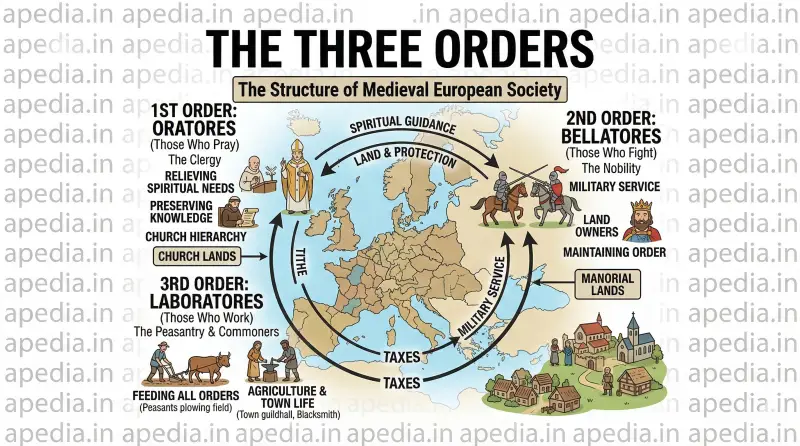
After the fall of the Roman Empire, Germanic groups occupied parts of Italy, Spain, and France. In this era of frequent military conflict, a new social organization centred on land control emerged, known as feudalism. French priests categorized society into three 'orders': those who pray (clergy), those who fight (nobility), and those who work (peasantry).
The Second Order: The Nobility
- Vassalage: The nobility controlled land through a practice called 'vassalage'. A noble accepted the king as his seigneur (senior) and promised loyalty in exchange for protection and a grant of land.
- The Manor: A lord owned vast tracts of land, including his private manor-house, fields, pastures, and the villages where his tenant-peasants lived. These manorial estates were largely self-sufficient.
- The Knights: Due to localized wars from the ninth century, amateur peasant-soldiers were insufficient, leading to the rise of specialized cavalry called knights. A lord would give a knight a piece of land called a 'fief' in exchange for a fee and a promise to fight for him.
📝 Concept Check 1
1. The term 'feudalism' is derived from the German word 'feud'. What does it mean?
It means 'a piece of land'.
2. What was the piece of land given to a knight by a lord called?
A fief.
3. Which Germanic tribe gave its name to the region of Gaul?
The Franks, making it 'France'.
⛪ Module 2: The Clergy and the Peasantry
The Catholic Church was a powerful, independent institution, while the vast majority of the population worked the land to sustain the upper orders.
The First Order: The Clergy
- The Church: Headed by the Pope in Rome, the Church had its own laws, owned vast lands, and could levy a tax called a 'tithe' (one-tenth of the peasants' agricultural produce).
- Monks and Nuns: Deeply religious Christians chose isolated lives in communities called abbeys or monasteries (e.g., St. Benedict in 529 CE). They took vows to remain in the abbey, spending time in prayer, study, and manual labour. Later, wandering preachers known as 'friars' emerged.
The Third Order: Peasants
- Free Peasants: They held their farms as tenants of the lord, owed military service, and had to provide 'labour-rent' by working on the lord's estate on specific days. Kings sometimes imposed a direct tax on them called the 'taille'.
- Serfs: Unfree peasants who cultivated plots belonging to the lord. They received no wages, could not leave the estate without permission, and were forced to use the lord's monopolies (mill, oven, wine-press).
📝 Concept Check 2
1. What was the tax collected by the Church, amounting to one-tenth of peasant produce?
The tithe.
2. What direct tax did kings occasionally impose on peasants?
The taille.
3. How did friars differ from regular monks?
Friars chose not to be based in a monastery, moving from place to place to preach and living on charity.
📈 Module 3: Growth, Towns, and the 14th Century Crisis
From the 11th century, Europe experienced a warm climatic phase, leading to agricultural expansion and the rise of towns, but this was halted by devastating crises in the 14th century.
Agricultural and Urban Expansion
- New Technology: Cultivators switched from wooden ploughs to heavy iron-tipped ploughs with mould-boards, and replaced the neck-harness with the shoulder-harness for animals.
- Three-Field System: Farmers transitioned from a two-field to a three-field rotation, immediately increasing food production and the availability of vegetable proteins.
- The Fourth Order: As agriculture improved, population grew, leading to the revival of towns and trade. Towns offered freedom; a serf who stayed hidden in a town for "one year and one day" became free. Town economic life was controlled by associations called 'guilds'.
The Crisis and New Monarchs
- The Black Death: By the early 14th century, a colder climate returned, leading to famines. Between 1347 and 1350, the deadly bubonic plague (Black Death) wiped out roughly 20% of Europe's population.
- Social Unrest: Depopulation caused a severe labour shortage, leading to a massive increase in wages. When lords tried to revive old unpaid labour services, violent peasant revolts erupted in Flanders, France, and England.
- Political Shifts: In the 15th and 16th centuries, "new monarchs" (like Louis XI of France and Henry VII of England) built standing armies and permanent bureaucracies funded by taxes, transitioning away from feudal levies towards royal absolutism.