🌍 The World Population: Distribution, Density and Growth
📊 Module 1: Patterns of Population Distribution
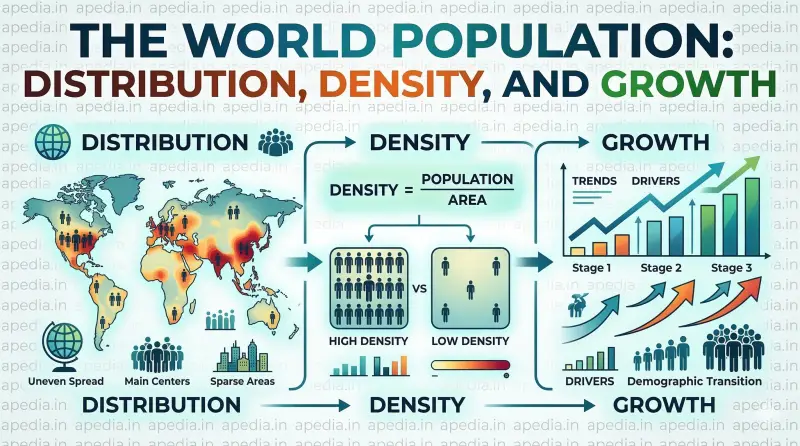
The term "population distribution" refers to the way people are spaced over the earth's surface. The distribution of the world's population is highly uneven. As George B. Cressey famously remarked about Asia, "Asia has many places where people are few and few places where people are very many." This statement rings true for the entire globe.
Key Global Patterns
- Concentration: About 90% of the world's population lives in just 10% of its land area.
- The Top 10: The ten most populous countries contribute to about 60% of the world's population. Six of these ten countries are located in Asia (China, India, Indonesia, Pakistan, Bangladesh, and Russia - which spans both Asia and Europe).
- Density: To understand the ratio between the numbers of people to the size of land, we use Population Density. It is calculated as Density = Population / Area (usually expressed as persons per square kilometer).
📝 Concept Check 1
1. What percentage of the world's population lives in just 10% of its land area?
Approximately 90%
2. How many of the world's top 10 most populous countries are located in Asia?
Six
3. What is the formula for calculating Population Density?
Population divided by Area
4. Who stated that "Asia has many places where people are few and few places where people are very many"?
George B. Cressey
🏞️ Module 2: Factors Influencing Population Distribution
People do not choose where to live randomly. Their choices are dictated by a combination of geographical, economic, and social factors that either attract them to an area or push them away.
The Three Main Pillars
- Geographical Factors: Water Availability: The most critical factor; river valleys are highly populated. Landforms: Flat plains are preferred over rugged mountains for agriculture and roads. Climate: Extreme climates (deserts, polar regions) deter settlement, while Mediterranean climates attract people. Soils: Fertile loamy soils support intensive agriculture.
- Economic Factors: Minerals: Mining areas attract skilled and semi-skilled workers (e.g., Katanga Zambia copper belt). Urbanization: Cities offer better employment, education, and medical facilities. Industrialization: Factory belts provide massive employment opportunities (e.g., Kobe-Osaka region in Japan).
- Social and Cultural Factors: Places with religious or cultural significance attract people, while areas with social or political unrest experience population out-migration.
📈 Module 3: Population Change and Demographic Transition
Population change is a dynamic process driven by three primary components: Births, Deaths, and Migration.
Migration and Demographic Theories
- Migration Factors: People migrate due to Push factors (things that drive people away like unemployment, war, natural disasters) and Pull factors (things that attract people like better jobs, peace, good climate).
- Demographic Transition Theory: This theory explains how a population changes from an agrarian, illiterate society (High Birth & Death rates) to an industrial, literate society (Low Birth & Death rates).
- Stage 1: High fertility and high mortality (low population growth).
- Stage 2: Fertility remains high, but mortality drops drastically due to better sanitation and healthcare (rapid population explosion).
- Stage 3: Both fertility and mortality decline significantly (population stabilizes).
- Thomas Malthus's Theory (1798): Malthus argued that human population grows geometrically (1, 2, 4, 8) while food supply grows arithmetically (1, 2, 3, 4), inevitably leading to famine, disease, or war unless population is controlled.
📝 Concept Check 2
1. Does urbanization act as a push or a pull factor?
Pull factor
2. Which stage of the demographic transition features a high birth rate but a rapidly falling death rate?
Stage 2
3. Who proposed the theory that population grows geometrically while food grows arithmetically?
Thomas Malthus
4. The Kobe-Osaka region of Japan is densely populated primarily due to which economic factor?
Industrialization