🏛️ Thinkers, Beliefs and Buildings: Cultural Developments
📜 Module 1: A Glimpse of Sanchi and the Background of Religion
The period from c. 600 BCE to 600 CE was a time of intense intellectual and religious ferment across the world. In India, it saw the emergence of various thinkers who attempted to understand the mysteries of existence.
Preserving Sanchi and Early Traditions
- The Survival of Sanchi: The Stupa at Sanchi (Madhya Pradesh) is one of the best-preserved ancient monuments. It survived largely due to the wise decisions of the rulers of Bhopal, Shahjehan Begum and her successor Sultan Jehan Begum, who funded its preservation and built a museum instead of allowing the British and French to take the original gateways away.
- The Sacrificial Tradition: The early Vedic tradition, compiled in the Rigveda (c. 1500-1000 BCE), consisted of hymns praising deities like Agni, Indra, and Soma. These were chanted during sacrifices performed to pray for cattle, sons, health, and long life.
- New Questions: Later texts like the Upanishads show that people began questioning the meaning of life, the possibility of life after death, and the nature of rebirth.
- Debates and Thinkers: Buddhist texts mention as many as 64 sects or schools of thought. Teachers travelled from place to place, engaging in debates in kutagarashalas (huts with pointed roofs) or groves, trying to convince one another of their philosophies.
📝 Concept Check 1
1. Which two Begums of Bhopal played a crucial role in preserving the Sanchi Stupa?
Shahjehan Begum and Sultan Jehan Begum.
2. Which ancient text contains hymns in praise of Agni, Indra, and Soma?
The Rigveda.
3. What is a 'kutagarashala'?
A hut with a pointed roof where travelling teachers and philosophers held debates.
4. Why did the rulers of Bhopal refuse to give the Sanchi gateways to the French and English?
To preserve the monument intact at its original site, offering plaster-cast copies instead.
🧘 Module 2: The Message of Mahavira and the Buddha
Among the many wandering teachers, Vardhamana Mahavira and Siddhartha Gautama (the Buddha) became the most influential, challenging the authority of the Vedas.
Jainism and Buddhism
- Jainism: The core of Jainism is that the entire world is animated; even stones and water have life. Non-injury (ahimsa) to living beings is their central principle. Mahavira was the 24th Tirthankara (great teacher). Jaina monks take vows to observe non-violence, abstain from stealing, lying, owning property, and observe celibacy.
- The Buddha's Enlightenment: Born as Siddhartha in the Sakya clan, he left his sheltered palace life after seeing an old man, a sick man, a corpse, and a peaceful ascetic. After extreme penance, he meditated under a Bodhi tree and attained enlightenment, becoming the Buddha (the Enlightened One).
- Teachings of Buddhism: The Buddha taught that the world is transient (anicca) and soulless (anatta). Sorrow (dukkha) is intrinsic to human existence, but one can end the cycle of rebirth by following a path of moderation (the Middle Path) between severe asceticism and self-indulgence.
- The Sangha: He founded an organization of monks (bhikkhus) called the sangha. Later, women were also admitted as bhikkhunis, with Mahapajapati Gotami (his foster mother) being the first.
📝 Concept Check 2
1. What is a 'Tirthankara' in Jainism?
A great teacher who guides men and women across the river of existence.
2. What are the core philosophical concepts of the world according to Buddhism?
It is transient (anicca) and soulless (anatta).
3. What was the organization of Buddhist monks called?
The Sangha.
4. Who was the first woman to be ordained as a bhikkhuni in Buddhism?
Mahapajapati Gotami, the Buddha's foster mother.
🕍 Module 3: Stupas and Buddhist Architecture
As Buddhism spread, people built monuments called Stupas over the bodily relics of the Buddha or objects he used, treating the entire site as sacred.
Structure and Symbolism of the Stupa
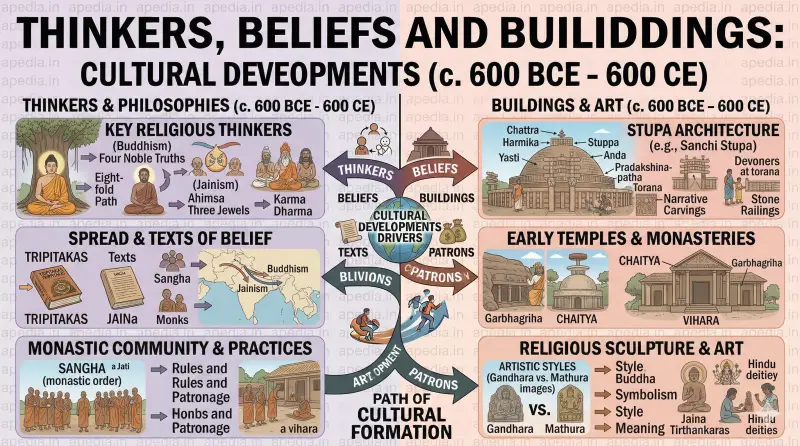
- Architecture: A stupa originated as a simple semi-circular mound of earth called an anda. Above it was a balcony-like structure called the harmika, representing the abode of the gods. Rising from the harmika was a mast called the yashti, often surmounted by a chhatri or umbrella.
- Donations: Stupas at Sanchi and Bharhut were built from donations made by kings (like the Satavahanas), guilds (like the ivory workers), and ordinary men and women, including monks and nuns.
- Symbols of the Buddha: Early sculptors did not show the Buddha in human form. Instead, they used symbols: an empty seat (meditation), the stupa (mahaparinibbana/death), and the wheel (the first sermon at Sarnath).
- Popular Motifs: Many sculptures at Sanchi depict stories from the Jatakas. Other figures, like the beautiful woman swinging from a tree (shalabhanjika), were integrated from popular, non-Buddhist beliefs to make the religion more appealing.
📝 Concept Check 3
1. What were Stupas built to house?
The bodily relics of the Buddha or objects he used.
2. What does the 'harmika' on a stupa represent?
A balcony-like structure representing the abode of the gods.
3. In early Buddhist art, what did the symbol of the wheel represent?
The Buddha's first sermon delivered at Sarnath.
4. What is the 'shalabhanjika' motif found at Sanchi?
An auspicious symbol of a woman whose touch caused trees to flower and bear fruit.
🕉️ Module 4: Mahayana Buddhism and Puranic Hinduism
By the first century CE, significant shifts occurred in both Buddhist and Brahmanical traditions, leading to the rise of saviour figures and temple architecture.
New Religious Movements
- Mahayana Buddhism: Early Buddhism focused on individual effort to attain nibbana. Over time, the idea of a saviour emerged. The Buddha was increasingly worshipped as a deity, and the concept of Bodhisattvas (deeply compassionate beings who delay their own salvation to help others) became central. This new, image-worshipping tradition was called Mahayana (the "Great Vehicle"), while the older tradition was called Hinayana or Theravada.
- Puranic Hinduism: Similar saviour concepts grew in Hinduism through Vaishnavism (worship of Vishnu and his 10 avatars) and Shaivism (worship of Shiva, often symbolized by the linga). These complex mythologies were written down in texts called Puranas.
- Early Temples: To house the images of gods, the first temples were built. They started as a simple square room called the garbhagriha (shrine) with a single doorway. Later, a tall structure called a shikhara was built over the central shrine, and temple complexes grew to include assembly halls and massive walls.
- Rock-Cut Architecture: Parallel to constructed temples, magnificent artificial caves were carved out of solid rock to serve as shrines and monasteries, continuing a tradition that peaked in the spectacular Kailashnatha temple at Ellora.
📝 Concept Check 4
1. What is the fundamental difference between Mahayana and Hinayana Buddhism?
Mahayana focuses on saviour figures (Bodhisattvas) and idol worship; Hinayana relies on individual effort.
2. Who are Bodhisattvas in Mahayana tradition?
Compassionate beings who accumulate merit to help others rather than attaining immediate nirvana.
3. What is the core, square room of an early Hindu temple called where the deity's image is placed?
The garbhagriha.
4. What is the tall structure built directly over the garbhagriha called?
The shikhara.