🌍 Transport and Communication
🛣️ Module 1: Land Transport (Roads & Railways)
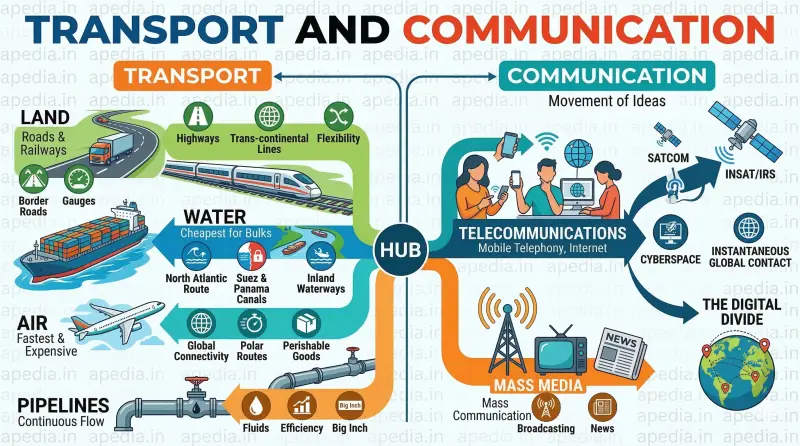
Land transport is the foundation of economic interaction. It involves the movement of goods and people over solid ground, primarily via roads and railways. The efficiency of a land transport network is a key indicator of economic development.
Roadways: Flexibility & Door-to-Door Service
- Characteristics: Roads offer unmatched flexibility, providing door-to-door service for short to medium distances. They can traverse difficult terrain more easily than railways. Road density (km per 100 sq. km) varies greatly, with North America having the highest.
- Highways: Major arteries connecting distant places, designed for fast-moving traffic with limited access. Major world highways include the Pan-American Highway (connecting Alaska to Chile/Argentina), Trans-Canadian Highway, and Australia's Stuart Highway.
- Border Roads: Roads constructed along international borders. They are vital for defense, connecting remote border settlements, and ensuring supply routes for security forces.
Railways: The Lifelines of Bulk Transport
Railways are ideal for moving heavy, bulky goods and large numbers of passengers over long distances. They require a specific infrastructure (tracks, stations) which depends on the gauge (the width between the two rails). The major gauges are Broad (>1.5m), Standard (1.44m), and Narrow. Highly dense networks exist in East-Central USA, Western Europe, and India.
📝 Concept Check 1
1. Which mode of transport is best suited for flexible, door-to-door service over short distances?
Roadways
2. What is the primary purpose of border roads?
Defense, supply to remote border settlements, and border security.
3. Name the major Australian highway connecting Darwin and Melbourne.
Stuart Highway
4. Which factor primarily determines the capacity and speed of a railway line?
The width of the track (Gauge)
💧 Module 2: Waterways & Air Transport
These modes utilize fluid mediums (water and air), which significantly influences their economics and speed.
Water Transport: Cheapest for Heavy Bulks
- Inland Waterways: Navigable rivers and canals. They offer the cheapest mode for heavy, non-perishable goods due to low friction and zero route maintenance costs. Examples: Rhine (busiest in Europe), Danube, Volga, Great Lakes-St. Lawrence Seaway in North America.
- Ocean Routes: Major world sea routes facilitate international trade. The North Atlantic Route, connecting Eastern North America and Western Europe, is the busiest and is known as the "Big Trunk Route." Other routes include the Mediterranean-Indian Ocean, Cape of Good Hope, and South Atlantic Routes.
- Major Shipping Canals:
- Suez Canal: Connects the Mediterranean Sea and Red Sea. No locks, entirely at sea level. Significantly shortened the route from Europe to Asia.
- Panama Canal: Connects the Atlantic and Pacific Oceans. Features a complex lock system to lift ships across the central terrain. Shortens the route from the US East Coast to the West Coast and Asia.
Air Transport: Fastest & Most Expensive
Air transport provides maximum speed and connectivity, especially over vast and difficult terrain (like polar regions or oceans). It is best suited for transporting expensive, perishable goods, or for urgent passenger travel. It is highly concentrated in the USA and Western Europe.
🌐 Module 3: Pipelines & Communication
Modern networks for moving resources and information.
Pipelines: Continuous Flow for Fluids
Pipelines are used to transport liquids and gases (like water, crude oil, petroleum products, natural gas, and even solids as slurry) from sources to markets. They ensure an uninterrupted flow and have low running costs, though the initial construction is expensive. Examples: "Big Inch" pipeline in the USA carries petroleum from the Gulf of Mexico to the NE states. Major pipelines are also expanding in Europe and the Middle East.
Communication: The Movement of Ideas
Communication systems have evolved from physical message carrying to instantaneous electronic transmission. They transmit ideas, facts, and news.
- Satellite Communication: Utilizing satellites in Earth orbit to facilitate telecommunications (radio, TV, telephone). Countries like India have developed their own satellite systems (INSAT, IRS) for communication, resource management, and navigation.
- The Internet & Cyberspace: The Internet has created a global, non-physical electronic medium called Cyberspace. It is the information world of computer networks where communication and data exchange happen instantaneously without physical movement, completely transforming how people connect, work, and access knowledge.
📝 Concept Check 2
1. Which major sea route is known as the "Big Trunk Route"?
The North Atlantic Sea Route
2. Does the Suez Canal utilize a system of locks?
No, it is a sea-level canal.
3. What is the main advantage of using pipelines for transporting oil or gas?
They provide a continuous, uninterrupted, and cost-effective flow of fluids.
4. What is the global electronic medium accessible by computer networks called?
Cyberspace