🏛️ Writing and City Life
🌍 Module 1: Mesopotamia and Urbanism
City life first began in Mesopotamia, a region situated between the Euphrates and Tigris rivers, which is now part of the Republic of Iraq. The name is derived from Greek words 'mesos' (middle) and 'potamos' (river).
Geography and the Rise of Cities
- Diverse Environments: The north features a steppe region where animal herding (sheep and goats) was common, while the south is a desert.
- Agricultural Wealth: Despite being a desert, the south supported the first cities because the Euphrates and Tigris brought fertile silt, making southern Mesopotamia's agriculture incredibly productive.
- The Significance of Urbanism: Cities are not just large populations; they represent an economy based on trade, manufactures, and services. Urban life requires a division of labour and social organization, as city dwellers are no longer self-sufficient.
- Transport: Efficient transport is vital for a city. In Mesopotamia, the cheapest mode of transportation was over water, using the rivers and natural channels to move grain and goods.
📝 Concept Check 1
1. Which two rivers enclose the region of Mesopotamia?
The Euphrates and the Tigris rivers.
2. What geographical feature defines southern Mesopotamia where the first cities arose?
It is a desert made fertile by river silt.
3. What is a key marker of urban life where people cease to be self-sufficient?
The division of labour.
✍️ Module 2: The Development of Writing
Writing began around 3200 BCE in Mesopotamia when society needed to keep records of increasingly complex transactions involved in city life.
Cuneiform Script
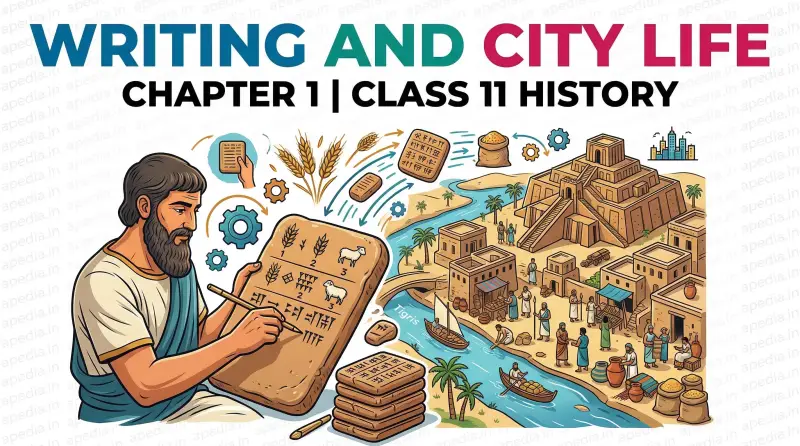
- Clay Tablets: Scribes wrote on moist clay tablets using the sharp end of a reed to press wedge-shaped ('cuneiform') signs into the surface. Once dried in the sun, these tablets became nearly indestructible.
- The System: Cuneiform signs did not represent single letters (like 'm' or 'a') but represented whole syllables (like 'put' or 'la'). This meant scribes had to memorize hundreds of complex signs.
- Language Evolution: The earliest known language was Sumerian. Around 2400 BCE, it was gradually replaced by Akkadian, though Sumerian continued to be taught in schools for centuries.
🏛️ Module 3: Temples, Kings, and City Life
Cities in southern Mesopotamia developed around temples, as centers of trade, or as imperial cities.
Institutions and Daily Life
- Temples: Early temples were small shrines made of unbaked bricks, serving as residences for gods like the Moon God of Ur, or Inanna (Goddess of Love and War). Temples gradually became the main urban institutions, organizing production, trade, and records.
- The Rise of Kings: Conflict over land and water was common. Successful war leaders began to settle, distribute loot to followers, and beautify temples, eventually establishing kingship and the authority to command the community.
- Life in Ur: Excavations at Ur reveal narrow, winding streets indicating an absence of town planning. There were no street drains; instead, rainwater was channeled into sumps in inner courtyards. The nuclear family was the norm.
📝 Concept Check 2
1. Who was the Mesopotamian Goddess of Love and War?
Inanna.
2. What type of family was the norm in Mesopotamian society?
The nuclear family.
3. Which excavated city was known for its narrow, winding streets and lack of street drains?
Ur.
📜 Module 4: Mari and the Legacy of Mesopotamia
While southern cities focused on agriculture, other cities prospered through trade. The lasting impact of Mesopotamia lies in its intellectual achievements.
Trade and Legacy
- Mari: Located upstream on the Euphrates in a pastoral zone, Mari became an exceptionally prosperous trading town. Its officials levied tolls on boats carrying wood, copper, wine, and tin between the south and the mineral-rich north.
- Mathematics and Time: The greatest legacy of Mesopotamia is its tradition of time reckoning and mathematics. They gave the world the division of the year into 12 months, the day into 24 hours, and the hour into 60 minutes.
- Libraries and Archives: Intellectuals preserved history. Assurbanipal, an Assyrian king, collected a massive library of cuneiform tablets at Nineveh, preserving ancient texts like the Epic of Gilgamesh.